




How to Make an E-Bike Faster: 12 Proven Ways to Boost Speed
That feeling is universal: you're riding your e-bike and loving it, but you wonder, "Could this be faster?" You're not alone in thinking this. The quest for more speed is natural, but you need to approach it the right way. This guide will show you exactly how to make an ebike faster using legal, safe, and effective methods. We won't cover sketchy changes that void your warranty or break the law. Instead, we'll show you how to make an electric bike faster by boosting its efficiency, reducing drag, and improving its existing systems for peak performance.
What "Faster" Really Means
Before we dive into the methods, let's redefine what "faster" truly means for an e-bike. It's not just about hitting a higher electric bike top speed, which is often legally restricted anyway. A better goal is to boost ebike performance across the board. When we talk about how to increase ebike speed, we're really focusing on three key areas that dramatically improve your ride quality:
- Quicker Acceleration: This is how quickly you can get up to your desired speed from a standstill or when coming out of a slow corner.
- Higher Average Cruising Speed: This is your ability to maintain a higher speed on flat ground with less effort from you and the motor.
- Better Speed Sustain: This is your bike's ability to hold its speed when facing challenges like headwinds, gentle inclines, or as the battery level drops.

Know Your Speed Limits
First, a crucial word on rules, warranty, and safety. Many riders immediately ask about the ebike speed limiter. Our advice is direct and firm: do not remove or tamper with it. E-bikes are legally classified based on their motor assistance speed limits. In the U.S., these are typically Class 1 (20 mph pedal-assist), Class 2 (20 mph throttle), and Class 3 (28 mph pedal-assist). You can learn more about local regulations from trusted sources on e-bike laws and classifications.
Attempting to bypass these factory-set limits introduces three major risks that far outweigh any perceived benefit:
- Legal Consequences: If you modify your e-bike to exceed the legal ebike top speed for its class, it may be reclassified as an unlicensed motor vehicle.
- Warranty Void: Manufacturers will immediately void the warranty for your motor, battery, and controller if they find evidence of tampering.
- Safety Hazards: An e-bike's frame, brakes, and tires are engineered and tested to be safe up to its classified speed.
Our guide focuses exclusively on making your bike faster within these legal and safe boundaries.
12 Ways to Get Faster
Now for the good stuff. The following 12 methods don't require illegal mods or a degree in electrical engineering. They all center on a single principle: increasing efficiency and reducing resistance. This is how you unlock "free speed" that's already hiding in your bike.
1. Keep Your Battery Full
The charge level of your electric bike battery has a direct impact on performance. We've all felt it: an e-bike that feels lively and powerful on a full charge becomes noticeably sluggish when the battery drops to its last bar. This isn't just your imagination; it's a phenomenon called voltage sag. A fully charged battery delivers higher voltage, allowing the motor to produce its maximum power. As the battery depletes, the voltage drops, and the motor's output decreases. The fact that battery level affects ebike speed is undeniable. To keep your battery healthy and delivering peak power, follow best practices for proper lithium-ion battery care, such as avoiding deep discharges and storing it at a partial charge.

2. Keep Your Battery Warm
Cold weather is a speed killer. Lithium-ion batteries perform optimally in a temperature range similar to what humans find comfortable. When the temperature drops near freezing, the battery's internal resistance increases significantly. This chokes the flow of electricity to the motor, limiting its power output and your speed. You can lose as much as 20-30% of your effective power and range in the cold. To improve your winter ebike performance, always store your battery indoors before a ride. If you ride frequently in the cold, consider investing in a neoprene battery cover, which acts like a jacket to help it retain its operational heat for longer. This simple trick can make a huge difference in ebike speed in cold weather.
3. Use the Right Tire PSI
This is the single biggest and easiest "free speed" upgrade you can make. Your tires are the only part of the bike touching the ground, and their pressure dictates a major force holding you back: rolling resistance. Under-inflated tires sag and create a larger contact patch, requiring more energy to roll. Properly inflated tires are firm, roll with much less effort, and reduce tire rolling resistance.
Check the sidewall of your tire for the manufacturer's recommended PSI range (e.g., "40-65 PSI"). For riding on paved roads, inflating your tires toward the higher end of this range will make you noticeably faster. Check your ebike tire pressure weekly, as tires naturally lose air over time. The best tire pressure for ebike speed is the one that is correct.
4. Switch to Faster Tires
Not all tires are created equal. The knobby, wide tires on a fat-tire e-bike are fantastic for sand or snow but create massive rolling resistance on pavement. If you primarily ride on paved roads, switching to a smoother, narrower tire can unlock a huge amount of speed. The tread pattern and rubber compound make a world of difference, a fact confirmed by extensive rolling resistance tests that show massive efficiency gaps between tire models. Here's a simple breakdown:
| Tire Type | Rolling Resistance | Grip/Comfort | Best For |
|---|---|---|---|
| Knobby/Fat Tires | High | Excellent | Off-road, sand, snow |
| Hybrid/Commuter | Medium | Good | Mixed surfaces, commuting |
| Slick/Road Tires | Low | Fair | Paved roads, speed |
If your riding allows it, changing from a fat tire vs slick tire speed profile is one of the most effective upgrades you can make. The best ebike tires for speed are almost always slicks.

5. Fix Annoying Brake Rub
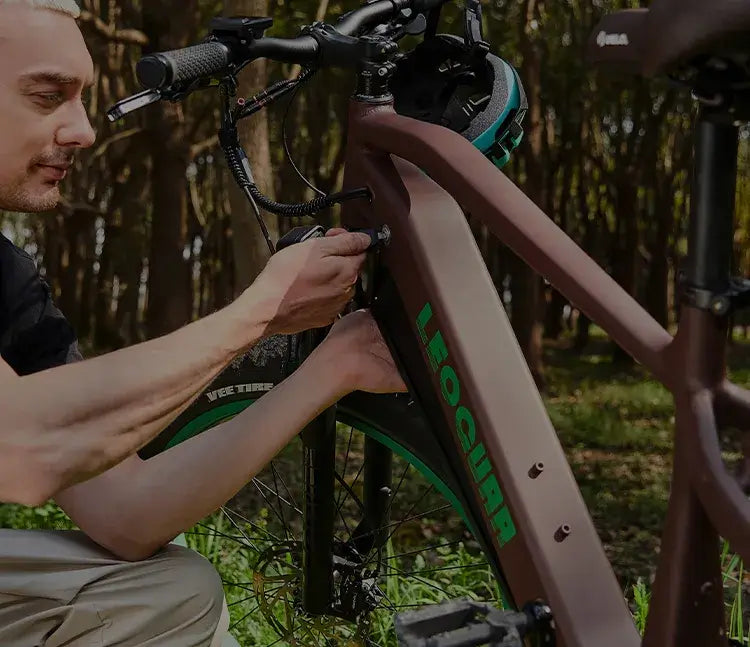
That faint shing-shing-shing sound you hear from your wheel isn't just annoying; it's the sound of you getting slower. Even the slightest brake drag, where the brake pad continuously rubs against the rotor, acts like a tiny brake that's always on. This constant friction scrubs off speed and wastes motor power. To check for it, lift one wheel off the ground and give it a spin. It should rotate freely and quietly for many rotations. If it stops quickly or you hear a scraping sound, you have brake drag. This is a common reason why an ebike feels slow and is often easily fixed with a simple brake caliper adjustment.
6. Clean and Lube Your Drivetrain
A dirty, gritty drivetrain is a massive power thief. The chain, cassette gears, and derailleur pulleys are a system of moving metal parts. When they are caked with old lube, dirt, and road grime, friction skyrockets. This friction wastes watts from both your legs and the motor before they ever reach the rear wheel. A clean ebike drivetrain can be several percentage points more efficient, as proven by studies showing how a clean drivetrain boosts efficiency. Improving your ebike drivetrain efficiency is a hands-on task that pays huge dividends in speed and component longevity.
Follow this simple process every few hundred miles:
1. Degrease: Use a chain cleaner tool and a quality bike degreaser to strip all the old gunk from your chain.
2. Clean: Use a brush and degreaser to scrub the cassette, chainrings, and derailleur pulleys until they shine.
3. Rinse & Dry: Rinse the components thoroughly with water and let them dry completely.
4. Lubricate: Apply one drop of an appropriate chain lube to the roller of each chain link.
5. Wipe Excess: This is the most important step. Use a clean rag to wipe the outside of the chain until it looks almost dry. The lube is needed inside the rollers, not on the outside where it attracts dirt.

7. True Your Wheels
A wheel that wobbles from side to side as it spins is not just a safety concern; it's a speed bump. This wobble, known as being "out of true," can cause brake rub and inefficient power transfer. It happens when spokes lose their uniform tension. You can do a quick visual check by watching the gap between your rim and brake pads as you spin the wheel. If the gap visibly changes, your wheel needs attention. While minor adjustments can be done at home, a professional wheel truing from a bike shop is a worthwhile investment. They will perform a spoke tension check and ensure your wheel is perfectly round and straight, which helps it roll faster and smoother.
8. Reduce Unnecessary Weight
It's a simple matter of physics: a lighter object requires less energy to accelerate. While shaving grams off the bike itself can be expensive, the easiest way to reduce ebike weight for speed is by evaluating what you carry. Are you hauling a massive, heavy-duty lock on a leisurely weekend ride? Do you have an empty rack and panniers on your daily commute? Removing just a few pounds of unnecessary cargo and accessories can make a noticeable difference in how quickly your bike accelerates and how easily it climbs hills. Every pound you shed is a pound the motor doesn't have to work to move.
9. Improve Your Aerodynamics
Once you get above 12-15 mph, air resistance becomes the single greatest force working against you. Your body acts like a giant sail. On our test rides, simply tucking into a more aggressive, forward-leaning posture on a flat road consistently added 1-2 mph to our cruising speed without changing the assist level. This is a fundamental concept in aerodynamic cycling positions.
To improve your ebike aerodynamics, try to get lower and narrower. Lean forward, bend your elbows, and tuck them in. Also, consider your gear. A bulky backpack creates significant drag. Switching to a frame bag or a more streamlined pannier that sits behind you can make a real difference in how you cut through the wind and how to ride faster on an ebike.
10. Use Your Gears Smarter
Gears aren't just for non-electric bikes. Using them correctly is vital for maximizing speed and efficiency, especially on a mid-drive e-bike. The motor, like your legs, has an optimal rotational speed (cadence) where it operates most efficiently. For most systems, this is between 70-90 RPM. Shifting gears allows you to keep the motor and your pedals spinning in this happy zone, whether you're climbing a hill or cruising on a flat. Trying to power up a hill in a high gear lugs the motor, drains the battery, and slows you down. The best gear for ebike speed is the one that lets you maintain a comfortable, brisk cadence. This is especially critical for mid drive gear ratio optimization.
11. Optimize Assist Settings
Many e-bikes offer ways to customize the feel of the motor assistance through the display. This isn't about illegal hacking; it's about using the available settings to your advantage. Some systems allow you to adjust the acceleration or "ramp-up" speed of the motor. Setting this to a more aggressive mode can provide quicker acceleration from a stop. The best pedal assist settings often involve a dynamic strategy: use a higher assist level to get up to speed quickly, then drop down to a lower, more efficient level to maintain that speed. This gives you the "faster feel" you want for ebike acceleration tips without constantly draining the battery at max power.
12. Keep Bearings Smooth
Your e-bike is full of bearings: in the wheel hubs, the bottom bracket (where the pedal cranks spin), and the pedals themselves. Over time, the grease in these sealed bearings can break down or become contaminated, increasing friction. While it's a small amount of drag in each component, it adds up. A bike with smooth, well-maintained bearings will coast for longer and require less energy to keep moving. While servicing these components is a job for a professional mechanic, having your wheel hub bearing and bottom bracket checked and serviced periodically is a key part of ebike maintenance for speed.

Safety Upgrades for Speed
As you work to make your bike faster and more efficient, your average speed will likely increase. Before you chase that extra mile per hour, ensure your safety equipment is up to the task. Faster speeds require shorter stopping distances and better control.
Consider an ebike brake upgrade to hydraulic disc brakes if you have mechanical ones; they offer significantly more power and better modulation. Ensure your tires are in good condition and rated for the speeds you'll be riding. Invest in a high-quality, certified helmet, bright front and rear lights, and comfortable, secure grips. A stable ebike is a safe ebike, and a safe ebike is a fast ebike.
Frequently Asked Questions
How to make an ebike faster without removing the limiter?
Focus on efficiency. The best methods are ensuring your tires are inflated to the correct PSI, cleaning and lubricating your drivetrain, switching to lower-rolling-resistance tires, and improving your riding posture to be more aerodynamic. These steps reduce drag and help you reach and maintain your bike's legal top speed with less effort.
Does higher tire pressure make an ebike faster?
Yes, absolutely. For riding on paved surfaces, higher tire pressure (within the manufacturer's recommended range) reduces the tire's contact patch with the road. This significantly decreases rolling resistance, allowing the bike to roll with less effort and maintain speed more easily. It's one of the most effective "free speed" adjustments you can make.
Why is my ebike slower when the battery is low?
This is due to "voltage sag." A full battery provides higher voltage, giving the motor maximum power. As the battery discharges, its voltage drops, which reduces the amount of power the controller can send to the motor. This results in noticeably weaker acceleration and a lower assisted top speed.
How to improve ebike acceleration vs top speed?
To improve acceleration, focus on reducing weight, using a higher pedal-assist level from a standstill, and keeping your battery fully charged. For better top speed (cruising speed), focus on reducing drag: use higher tire pressure, adopt an aerodynamic posture, and switch to slicker tires. Using your gears to keep a high cadence helps with both.
Is it legal to modify my ebike to go faster?
No, modifying your ebike to exceed its class speed limits is not legal in most jurisdictions. It can reclassify your bike as an unlicensed motor vehicle, void your warranty, and create safety hazards. Focus on the legal methods in this guide to maximize your bike's performance within its designed parameters.


Leave a comment