




Electric Bike for Big Guys: 7 Stress Points to Check Before Buying
The Frame's True Strength
If you're a bigger rider, shopping for an electric bike for big guys comes with tough questions. "Will this frame hold me?" "Will the motor work on hills?" "Is this safe?" These worries make sense because most standard e-bikes are built for riders under 250 lbs.
Pushing a standard bike past its limits isn't just about poor performance. It's about safety, how long the bike lasts, and your confidence on the road. Instead of just listing bike models, we'll give you something better: an expert guide. We'll break down the 7 key areas where an e-bike is most likely to fail a heavier rider. When you understand how to check these areas, you can judge any electric bike for big guys and make a smart choice, avoiding expensive mistakes and getting a bike that's built to last.
The frame is your bike's foundation. Its strength is about more than just one number on a spec sheet. Here's how to check its strength for a heavy rider properly.
Beyond Payload Numbers
You'll see "Max Payload" numbers listed, often up to 400 lbs or more. But you need to understand what this really means. As noted by industry experts, a bike's payload limit includes the rider weight and any extra equipment. Also, a high payload on a cargo bike isn't the same as a frame built for one heavier rider. You create different stresses when you speed up, brake, and turn corners.
A Strong Frame Checklist
A truly heavy-duty frame has specific design features. Look for a company that clearly markets their product as an electric bike for big guys, as they have likely made these key areas stronger.
- Material: The industry standard for a strong yet reasonably light frame is 6061 or 7005 series aluminum. These metals offer excellent strength while staying light. Many purpose-built bikes from brands use reinforced 6061 aluminum frames.
- Welds: Check the joints, especially around the head tube (where handlebars connect) and bottom bracket (where pedals connect). Look for clean, even welds that look like stacked coins. Messy, uneven, or marked-up welds are warning signs of poor quality.
- Gussets: A gusset is a small, triangle-shaped piece of metal welded into a frame joint for extra strength. Having gussets, especially where the down tube and head tube meet, clearly shows the company built the frame for high-stress use.
- Warranty: A company's confidence in their frame shows in the warranty. Look for a 5-year or lifetime frame warranty. This strongly indicates the bike will last long-term.
Why Torque Trumps Watts
When it comes to motor performance for a heavier rider, the most advertised number—Watts—isn't the most important one. The real hero is torque.
The Wattage Myth
Think of it this way: Watts (W) measures power output, like horsepower in a car. It determines top speed. Torque, measured in Newton-meters (Nm), is the turning force that gets you moving from a stop and powers you up hills. To pull a heavy load, you need torque. A 750W motor is common and solid, but its real-world performance depends on its torque rating.
The Golden Number: 80Nm+
For a rider over 250 lbs, we recommend a motor that delivers at least 80 Newton-meters (Nm) of torque. A motor with 85-90Nm will feel much more powerful on hills than another "750W" motor that only makes 60Nm. Many purpose-built e-bikes for heavy riders feature motors from Bafang, Mivice, or other brands rated at 80Nm, 90Nm, or even over 100Nm for top off-road models. This is the number that ensures you won't struggle on steep hills.
Hub vs. Mid-Drive
- Hub Motors: Located in the center of the rear wheel, powerful hub motors (750W+, 80Nm+) are a great, reliable, and affordable choice for most big riders. They give a strong "pushing" feeling and are found on many of the best-value heavy-duty e-bikes.
- Mid-Drive Motors: Located at the pedals, these motors use the bike's gears for incredible efficiency, especially on very steep or technical climbs. They offer a more natural "extra leg" feel but usually cost more.
Your Critical Safety System
For a heavier rider, stopping power is not a feature—it's a must-have safety requirement. More weight moving at speed needs much more force to stop safely and quickly.
Hydraulic Brakes Are Essential
Mechanical disc brakes, which use a steel cable to work the brake, are simply not good enough. They need more hand strength, offer less control, and can get weak with heavy use. Hydraulic disc brakes, which use fluid to transfer force, are the only acceptable option.
| Feature | Mechanical Disc Brakes | Hydraulic Disc Brakes |
|---|---|---|
| Stopping Power | Good | Excellent |
| Hand Effort | Higher | Lower (Less Fatigue) |
| Consistency | Fades on long hills | Consistent, Self-Adjusting |
| Recommendation | Acceptable for light riders | Essential for riders >250 lbs |
Look for Larger Rotors
The brake rotor is the metal disc the brake pads squeeze onto. A larger rotor gives more power and gets rid of heat better, preventing brake fade on long downhills. For an electric bike for big guys, look for rotors that are 180mm across at minimum. Some heavy-duty models will even use 203mm rotors for maximum stopping power.
Wheels and Tires
This is where your weight meets the road. Standard wheels can bend, and spokes can break under the load of a heavier rider. Strong wheels and the right tires are critical for safety and ride quality.
It's All in the Spokes
The strength of a wheel mainly comes from its spokes. Look for wheels with more spokes, typically 32 or, even better, 36 spokes. Also, check for thicker spoke gauge, like 12-gauge or 13-gauge spokes, which are stronger than the standard 14-gauge spokes found on most bikes. These features prevent wheels from easily going out of shape and can support more weight.
Fat Tires Are Your Friend
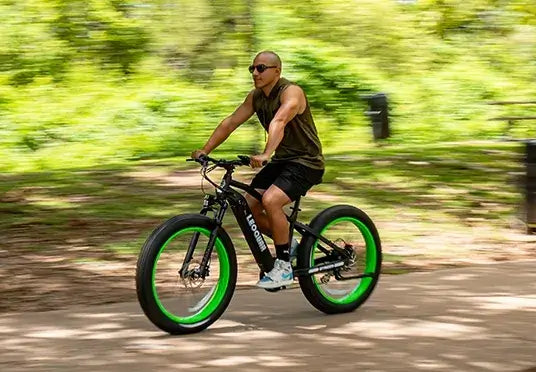
Wider tires, often called "fat tires" (typically 3 to 4 inches wide), are a huge advantage. They create a larger contact area with the ground, giving better stability and grip. More importantly, their large air volume acts like natural suspension, smoothing out bumps and cracks in the road for a much more comfortable ride.
They also spread the rider's weight over a wider area, reducing stress on the wheel itself. For paved and light trail use, running them at slightly lower pressure (like 15-20 PSI) can dramatically improve comfort.
Suspension for Comfort
For a heavier rider, electric bike suspension isn't a luxury for off-roading; it's a key part for comfort and control on any surface. It absorbs impacts that would otherwise shake both you and the bike's frame.
Front vs. Full Suspension
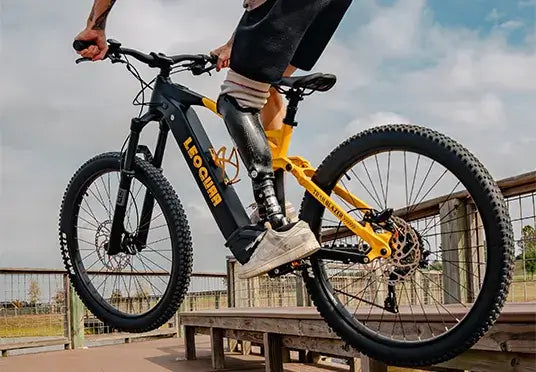
- Front Suspension (Hardtail): A suspension fork at the front of the bike is excellent for absorbing bumps from potholes and uneven pavement. This is the most common and practical setup, giving major comfort improvement without the cost and complexity of a rear shock. Look for forks with at least 80mm of travel.
- Full Suspension: This features suspension in both the front and rear. It offers the ultimate in comfort, protecting you from nearly all road and trail bumps. While fantastic, it adds weight, cost, and maintenance.
Air vs. Coil Suspension
Most importantly, look for a suspension fork that you can adjust. An air-sprung fork is ideal because you can use a special pump to set the air pressure exactly to your body weight, ensuring the suspension works well for you. A basic coil-sprung fork may be too soft and bottom out easily under a heavier load.
Cockpit and Geometry
How the bike fits you is just as important as its parts. The "cockpit"—handlebars, stem, and saddle—determines your riding position and overall comfort.
An Upright, Confident Posture
Many big and tall riders find that leaning forward puts too much strain on their wrists, shoulders, and lower back. Look for an electric bike for big guys that promotes a more upright and relaxed riding position. This is often achieved with swept-back handlebars that bring the grips closer to you and an adjustable stem that lets you raise the height of the handlebars for a custom fit.
The Saddle Matters
The stock saddle on many bikes is an afterthought. As a bigger rider, you will benefit greatly from a wider, more cushioned saddle that gives better support. Even better, consider adding a suspension seatpost. This is a seatpost with a built-in shock absorber that takes the harshness out of any bumps the rear wheel hits. It's a relatively cheap upgrade that can transform the comfort of your ride.
Battery and Range
A powerful motor and a heavier rider will use more energy from the battery. To ensure you have enough range and aren't left with a dead battery miles from home, battery capacity is key.
Capacity for the Real World
Battery capacity is measured in Watt-hours (Wh). While a 500Wh battery might be enough for a 150 lb rider, it will give much less range for a 300 lb rider, especially when climbing hills. We recommend looking for a battery with at least 600-700Wh. Many top-tier heavy-duty models now offer batteries in the 750Wh to 960Wh range, giving confidence for longer rides. Some brands even offer dual-battery systems that can push capacity over 1,000Wh.
Safety and Certification
Make sure the battery and charging system are UL Certified (UL 2849). This is an independent safety standard that tests for fire and electrical shock dangers. It's a critical mark of quality and safety that you should not overlook.

Ride with Confidence
Choosing the right electric bike for a big guy isn't about finding a bike that will simply "work." It's about investing in a machine that is built for your safety, made for long-term durability, and designed for your comfort. By using these seven stress points—Frame, Motor, Brakes, Wheels, Suspension, Cockpit, and Battery—as your guide, you can move past the marketing hype and analyze any bike like an expert. You now have the knowledge to ask the right questions and make a purchase with total confidence. Happy riding.
FAQ
Q: What's the difference between payload capacity and actual weight limit for heavy riders?
A: Payload capacity includes your weight plus any cargo or accessories, but it doesn't account for the dynamic forces created when a heavier rider accelerates, brakes, or corners. A bike rated for 400 lbs payload might not handle a 300 lb rider's actual riding stresses safely.
Q: Why is torque more important than wattage for heavier riders?
A: Torque measures the rotational force that gets you moving from a stop and powers you up hills, while watts determine top speed. A heavier rider needs at least 80Nm of torque to climb hills effectively, regardless of the motor's wattage rating.
Q: Are mechanical disc brakes sufficient for riders over 250 lbs?
A: No, hydraulic disc brakes are essential for heavier riders. They provide better stopping power, require less hand effort, and maintain consistent performance under heavy use, unlike mechanical brakes which can fade during long descents.
Q: What tire width should I look for as a bigger rider?
A: Fat tires (3-4 inches wide) are ideal for heavier riders. They provide better stability, distribute weight over a larger area, and act as natural suspension for improved comfort. They also reduce stress on the wheels themselves.
Q: How much battery capacity do I need as a heavier rider?
A: Look for at least 600-700Wh battery capacity. Heavier riders and powerful motors drain batteries faster, especially on hills. Many heavy-duty models offer 750-960Wh batteries, and some have dual-battery systems exceeding 1,000Wh for extended range.


Leave a comment