




What Makes a Good Off-Road Electric Bike for Rough Terrain?
In 2026 the best off-road electric bike features a mid-drive motor, full suspension and tough fat tyres capable of dealing with mud, gravel and rocky ground; it is built for use on both mountain trails and for weekend trips – hence making it the ideal electric bike for off-road riding.
Although an e-bike with knobby tyres may seem suited for off-road riding, genuine off-road performance lies much further than appearance. An off-road capable e-bike needs a robust frame, a good power system, reliable components, and weather protection all working in unison. Even though a lot of e-bikes look suitable, very few of them can cope with tough use away from paved surfaces.
This guide is going to get rid of all the confusing jargon and show you what's really important. We'll examine the main areas that contribute to a bike being a true performer: Frame & Geometry, Motor & Battery, Suspension & Brakes, and some key Durability Details that distinguish the best from the rest. By the end of it, you'll be able to identify a genuinely tough machine and make your purchase with confidence.
The Foundation: Frame and Geometry
The frame puts the off-road ebike together and is what determines both the bike's strength and the way it handles on rough ground; a weak frame can result in a shaky ride and may break when under pressure.
Material Matters
The majority of well-made off-road ebikes employ aluminium alloys rather than carbon fibre or steel. You should look for frames constructed from 6061 or 7005 series aluminium, since these materials provide excellent strength without being too heavy, resist rust well, and can be formed into durable designs at a reasonable cost.
The 6061 aluminium is the choice of most reliable off-road e-bikes since it copes well with the stresses of the motor and rough terrain. Although carbon fibre is lighter and can be stiffer, it is a lot more expensive and is more likely to break when hit. Steel, on the other hand, lasts indefinitely but is too heavy for quick trail bikes, particularly when a motor and battery are included.
Trail-Focused Geometry
The geometry of a bike refers to the angles and dimensions that determine its shape. For off-road riding, this is more important than the material of the frame since it is what makes the bike feel stable and safe when going downhill rather than attempting to throw the rider over the handlebars.

Key ideas include:
- The angle of the slack head tube shows how the front fork is positioned in relation to the ground; a slacker angle of 64 to 66 degrees on trail bikes causes the front wheel to be pushed out more, which increases the bike's stability when travelling at high speeds and prevents it from feeling bouncy on steep declines. Street bikes generally have a steeper angle (68 degrees or more) in order to allow for quicker turns on tarmac.
- The steep seat tube angle places your body weight in the correct position above the pedals, increasing your power and aiding you when climbing steep, technical hills with the motor assisting.
- Low Bottom Bracket: A lower bottom bracket (where pedals attach) drops your center of gravity, making the bike feel planted and stable in corners.
| Geometry Feature | Off-Road Ebike (Trail) | Commuter/Hybrid Ebike |
|---|---|---|
| Head Tube Angle | 64-66° (Slack) | 68-70° (Steep) |
| Feel at Speed | Stable, confident | Twitchy, nervous |
| Best Use | Fast descents, rough terrain | Slow-speed maneuverability |
Weld Quality and Construction
Frame quality can be assessed by examining the welds; the better the welds the cleaner and more even they appear, resembling a straight line of coins. This is a sign of skilled work and good quality control and indicates that the frame will last.
Welds that are messy or uneven are a sign of work that has been done quickly and in a cheap manner. Moreover, you should look for gussets, which are small welded supports at places under stress such as where the head tube joins the down tube, since they indicate the frame was designed for tough off-road use.
The Heart: Motor and Battery
The power system is what makes an ebike electric, but there are great differences between motors and batteries. When it comes to trail riding, the way in which power is delivered is just as important as the amount of power you have.
Mid-Drive vs. Hub Motors
The decision you make is most important for the power system of your ebike; hub motors are located in the centre of the front or rear wheel, whereas mid-drive motors are positioned at the bottom bracket and drive the pedals directly.
| Feature | Mid-Drive Motor | Hub Motor |
|---|---|---|
| Weight Distribution | Central & Low (Better Balance) | In Wheel (Unbalanced) |
| Torque & Climbing | Excellent (Uses bike's gears) | Good (Can struggle on steep climbs) |
| Trail Feel | Natural, responsive | Less natural, can push/pull |
| Maintenance | More complex | Simpler |
When it comes to use in off-road conditions, mid-drive motors are preferable since the low point located in the centre gives the bike a balanced character similar to that of a normal Electric Mountain Bikes. Most important is the fact that mid-drive motors make use of the bike's existing gears, allowing you to change gears so that the motor will operate at its optimal speed.
This is very helpful on steep and technical climbs since the hub motors are capable of slowing down and overheating.
Decoding Power: Torque over Watts
Marketers prefer high watt figures, but it is torque that is more important when tackling trail obstacles. Watts have something to do with the power of the motor at a given speed, whereas torque, which is measured in Newton-metres (Nm), is the turning force that enables you to get moving from a standstill. It is the strength that allows you to climb rocky hills or go through mud.
A 750W motor may sound impressive, but a 500W motor with greater torque will feel considerably more powerful when climbing steep hills. If you're looking for a really capable off-road e-bike, you should choose one with a mid-drive motor that produces at least 85 Nm of torque. In order to see how various systems perform in real situations, it's best to refer to sources that carry out rigorous independent testing, since they usually test the systems on actual trails. For example, more affordable models such as the Rad Power Radster Trail or the Ride1Up Vorsa offer over 90 Nm of torque with motors of the 750W class—making them suitable for riders who are looking to save money but still want strong off-road power. These top off-road e-bikes under $3000 show that the ability to climb hills and carry cargo need not always come at a high price.
In a series of independent laboratory tests carried out in 2025, rugged trail bikes such as the Aventon Aventure and the Segway Xafari achieved high scores for their torque-to-weight ratios, reaching as much as 5.6 Nm per kilogram, which means they are capable of climbing steep gradients of 20% or more. These bikes also have IP65-rated waterproofing, full 140mm suspension, and 4 to 5-inch fat tyres that maintain good traction on loose ground. These specifications establish the standard for what it takes to define a genuinely rugged off-road e-bike.

Battery Endurance and Protection
The capacity of the battery determines how far you can go. It is measured in Watt-hours (Wh), which is the result of multiplying Volts by Amp-hours (Ah). To have a good experience on trails lasting between 2 and 3 hours, you should use a battery with 600Wh or higher.
The way the battery is placed in the frame is just as important; a battery that is fully built in and located inside the down tube is the best option. It remains protected from rocks, water, and damage caused by a crash, and at the same time makes the bike look neat and give it a sense of balance.
The outside battery should at least be secured and have good protection.
Why Off Road Ebikes Are Different From Regular E-bikes
Off-road e-bikes are specifically designed for use on difficult terrain and in severe outdoor conditions. Unlike city or commuter models, off-road e-bikes have to be able to take impacts, provide traction on all types of terrain, and include a longer battery life when used in unpredictable situations. The best e-bikes available for off-roading nowadays have waterproof parts, advanced suspension, and fat tyres which are designed to give good grip and balance.
Although fat-tire trail bikes are the ones that are most commonly used on difficult terrain, there are some riders who prefer electric gravel bikes when they are undertaking journeys on a variety of surfaces. Bikes such as the BMC URS AMP LT or the Whyte RHeO, with their drop handlebars, thinner knobby tyres and agile frames, provide long-distance comfort as well as the ability to climb on dirt roads, gravel switchbacks and fire trails. They are ideal for bikepacking and for navigating unknown routes since versatility is important in such situations.
A 2025 gravel e-bike buyer's guide states that the most rugged drop-bar models are now fitted with reinforced alloy frames, Bosch CX motors capable of producing a torque between 50 and 80Nm, and up to 150mm of suspension travel on either the fork or the seatpost. Since these bikes have 50mm or more of tire clearance for use on muddy or sandy tracks and include thru-axles as well as dropper posts rated at 150 to 200mm for descending steeply, they show that the term "gravel" does not any longer mean "lightweight only"; instead they are designed for adventure riding with control and confidence.
Control: Suspension, Brakes, and Tires
If you can't control it, all the power amounts to nothing. The components that link you and the bike to the trail are essential for a robust construction.
Suspension for Traction
- The Hardtail has a suspension fork only at the front. It is lighter and more efficient when climbing on smooth terrain, but it is less capable on difficult and technical ground.
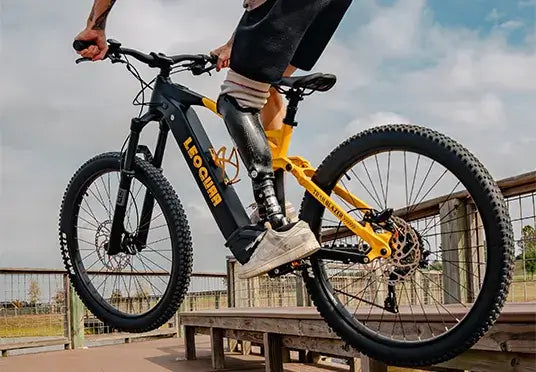
- Full suspension means that there is suspension at both the front and the rear, and it is most suitable for true off-road performance since it greatly enhances grip, control, and the rider's confidence when navigating difficult trails. Indeed, modern full-suspension electric mountain bikes such as the Aventon Ramblas or the Segway Xafari take off-road performance to the next level by combining aggressive trail geometry, mid-drive motors with a power output of 750W or more, and multi-link rear suspension. These bikes excel on singletrack, during descents, and on climbs that involve a lot of roots—offering the same smoothness and handling experience as is expected from top-quality analog mountain bikes, but with the help of electric power.
The distance that the suspension moves is referred to as 'travel'. For riding on all types of trails, a travel range of 120mm to 160mm is most suitable. When making a choice, you should select components from reputable manufacturers such as RockShox, Fox, and DVO, since these indicate a thoughtfully designed product.
Non-Negotiable Hydraulic Brakes
Since an off-road ebike is heavier and travels faster than a normal bike, it requires a great deal of stopping power, which mechanical disc brakes are unable to provide and so hydraulic disc brakes are an essential feature.
They offer considerably better stopping power, better control (that is, the ability to make fine adjustments to the braking force), and compensate for pad wear. Personally, the confidence you get from having reliable four-piston hydraulic brakes when descending a long and steep slope is great; you can gently touch the brakes with a single finger to precisely control your speed without getting tired in the process, which is very different from the indistinct, "on/off" sensation provided by cheaper systems.
To achieve the best performance, you should look for large brake rotors, 180mm or, even better, 203mm, since they cope with heat more effectively and provide more power.
Tires for Grip
The only part of the bike that makes contact with the ground is the tyres. Tyres that are thin and have a low profile are not suitable for a tough electric bike. You should look for tyres that are wide and have lugs, with a size between 2.4" and 2.8".
The width provides a large contact area which results in excellent grip when going around corners and during braking. Moreover, it is important to ensure that the tyres have a robust construction and are 'tubeless-ready'. With a tubeless arrangement, the inner tube is removed and this allows you to use a lower tyre pressure for even greater grip and almost eliminates pinch flats, which is one of the most common problems on trails.
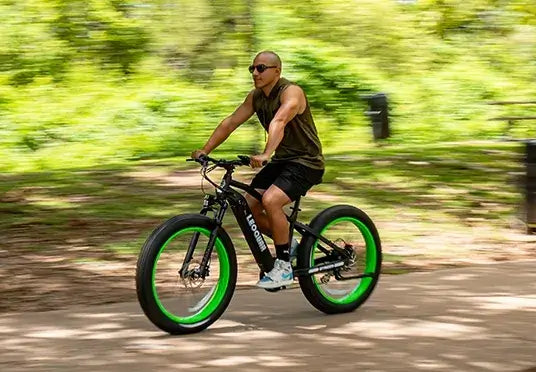
For anyone who has to ride through deep sand, mud, or loose snow, the top fat-tired off-road e-bike choices in 2026 feature enormous 26x4" tyres going with 1100W or more motors and long-range 60 to 80 mile batteries. Bikes such as the Mokwheel Obsidian or Basalt are designed for severe terrain by combining torque-packed drive systems, durable aluminium frames, and extended-range power packs that are built for adventure.
Beyond the Spec Sheet: Unsung Heroes
The true distinction between a good bicycle and a great one is usually found in details which are not highlighted in the marketing websites. These are the unnoticed features that guarantee long-term durability and an improved riding experience.
Sealed Bearings
A good off-road electric bicycle will fit sealed cartridge bearings in all its moving parts—namely the headset, the wheel hubs, and the suspension links. These bearings are complete units and are good at keeping dust, mud, and water out. In contrast, cheaper bikes usually have simple bushings which wear themselves down quickly and become loose, causing the bicycle to feel creaky and sloppy and requiring frequent repairs.
Drivetrain Quality
The motor places a great deal of stress on the drivetrain (this comprising the chain, cassette, and derailleur). Under this additional load, standard bike parts are likely to wear out or even break. The most reliable off-road electric bikes make use of drivetrains that are designed specifically for electric bikes, such as Shimano's Linkglide or SRAM's EX1 systems.
They are constructed using stronger chains and more durable cassettes in order to meet the high-torque requirements. The industry's transition to these components is a direct response to the need for improved reliability, since many of the parts are now tested according to the ISO 4210-10 standards for durability and safety.
Frame & Chassis Strength That Holds Up
In addition to their drivetrain durability, the top off-road e-bike brands for 2026 now stress the importance of frame-integrated durability figures when it comes to real-world ruggedness. The high-end models provide a peak power of 1300W, can carry a rider and cargo weight of up to 330 lbs, and are equipped with sealed battery cases rated for 70 or more miles per charge. Together with 203mm hydraulic disc brakes and 4 to 5 inch tires lined with slime, these systems are not only designed for performance but also for withstanding continuous use over rocks, roots, and throughout long days in remote backcountry areas.
Weatherproofing and IP Ratings
You will ultimately end up getting caught in the rain or having to go through deep puddles, so ensure that the electronic components of the bike—namely the motor, the battery, and the display—have an Ingress Protection (IP) rating; an IPX5 rating or higher is necessary.
This shows that the component is capable of withstanding a continuous spray of low-pressure water, which means it will be able to cope with heavy rain or a full post-ride wash.
Smart Cable Routing
Find bikes that have internal cable routing; in this case, the brake hoses and shift cables run inside the frame tubes rather than being fitted to the outside. It's not only a matter of appearance since this arrangement protects the important cables from being caught in branches, from being damaged in the event of a crash, or from becoming contaminated with dirt, thus ensuring that your braking and shifting remain smooth and reliable.
Top Features to Look for in the Best Off Road Ebike
- Mid-drive motor with high torque (70Nm+)
- Full suspension system
- IP65+ waterproof rating
- Fat tires (26" x 4" or larger) for traction on dirt, sand, or gravel
- Long-range battery (600–960Wh)
Biking electrically off the road is not all about power; it's also about having control, comfort, and confidence when travelling on difficult tracks.
Entry-Level Picks: Beginner-Friendly Off-Road Ebikes
For people who are new to trail riding, the most suitable all-terrain e-bikes for beginners provide stability, ease of use, and lenient control. Bikes such as the Lectric XP4 or RadExpand have adjustable power settings, hydraulic brakes, and tyres that are puncture-resistant because they are filled with slime, thus reducing the need for maintenance. These models concentrate on ensuring trail safety and giving the rider confidence without delivering excessive power—making them perfect for developing skills on fire roads and easy singletrack.
Conclusion: Your Ruggedness Checklist
A genuinely tough off-road ebike is not just a collection of parts but a thoughtfully designed system; it's a well-balanced machine since the frame's strength and shape give the powerful and responsive motor a confident foundation.
The suspension and the brakes have to be capable of controlling this power when riding on difficult terrain, and all the small points must be accurate if the system is to remain tough over many years of heavy use.
Use the "Ruggedness Scorecard" when you're shopping as a guide; if a bike meets all of these criteria, you can be sure that it's been built for the trail.
- The frame is made of 6061/7005 aluminium and has a trail-focused geometry with clean welds.
- The motor is a mid-drive type with a torque output of 85Nm+.
- Battery: capacity of 600 watt-hours and above, with an integrated and protected design.
- Suspension: Full suspension with travel of 120mm or more.
- Brakes: 4-piston hydraulic disc brakes with 180mm or larger rotors.
- Tires: 2.4"+ Wide, Tubeless-Ready.
- Durability features an e-bike specialised drivetrain, sealed bearings, and an IPX5+ rating.
When you start off by choosing a high quality bike, you're not only purchasing a bike, but also making an investment in a safer, more enjoyable, and longer-lasting off-road experience.
FAQ
How does a standard e-bike differ from an off-road e-bike?
Off-road electric bikes have suspension, tough tyres, and more powerful motors so that they can cope with muddy trails and hills.
What is the best ebike for off-roading?
The most suitable electric bikes for off-roading are those which have wide tyres, waterproof parts, and a mid-drive system since this gives them better climbing ability and control.
Is it legal to ride an electric bike off road?
So long as the trail or park permits electric bikes, many electric bikes designed for use on trails are rated Class 1 or 2.
What gives a fat-tired e-bike its suitability for off-road terrain?
Fat tyres provide stability and traction on mud, gravel, and sand, particularly when used with front suspension.
For how long will an off-road ebike battery last?
The range of the best off road ebike will be between 40 and 70 miles on a full charge, depending on the size of the battery and the type of terrain.


Leave a comment