

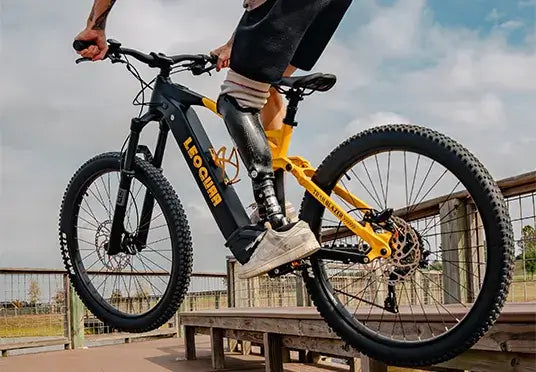


Why an Electric Road Bike May Struggle on Broken City Pavement?
On smooth and new pavement, an e-road bike is pure joy since the narrow tires slide easily, the motor keeps you moving, and you can travel long distances without completely exhausting your legs. However, as soon as you come to a street full of potholes and loose gravel, the thin tires won't tolerate any error at all; you have to reduce your speed, choose your route with care, and allow yourself enough time to react before you start bouncing all over the place.
The bike isn't defective; it's just performing the function for which it was designed on a surface that no longer suits it. On broken asphalt, the tires have less room to take in a shock, more vibration is transmitted through the frame, and you have less time to react. This is exactly how you will feel on rough city streets—and the things you can alter before your next ride.
Why Do Electric Bike Tires Feel So Harsh
It is the tires that suffer before any other part of the bike does. Most e-bikes designed for use on roads have narrower tires than those of their commuter, hybrid, or fat-tire types. This helps to reduce rolling resistance but also means there is less air space between the rim and the road.
A pothole can pinch a narrow tire
If you encounter a sharp edge in a pothole, the tire will compress against the rim. A severe impact might pinch the tube, dent the rim, or cause the wheel to become out of true. Since the motor and the battery increase the weight, the tires have to carry a greater load than they would if the bike were not electric.
You should not set the tire pressure to the highest number printed on the tire's sidewall. With too much pressure, the ride will become harsher, and the tire may skip over broken patches. Instead, set the pressure within the manufacturer's recommended range, then take your weight, the amount of cargo, the tire width, and the road conditions into consideration.
Street cracks can steer the front wheel
Long cracks, the gaps in the drains, and the joints in the road that run parallel to your path are plain tire traps. When you're using skinny tires and come across one at a shallow angle, the crack will catch your front wheel and pull you straight into the groove. After your tire gets stuck in there, it's very difficult to steer yourself out without rocking the handlebars or falling over.
Make sure you look well down the road so that you will have time to reduce your speed before coming to a crack. If you have to cross one, turn a little and go across it at a sharp angle rather than going parallel to it. And in all circumstances, always check over your shoulder before you move; keeping a steady course is much safer than making last-second swerves into the traffic out of panic.

Road Bike Frames Send Bumps to Your Hands
Since many electric road bikes are equipped with a rigid fork and a very stiff frame, this is advantageous if you want all of your pedaling power to be converted into speed, but it does mean that the bike offers no cushioning at all and so each and every bump, crack, and pothole is transmitted directly through the handlebars and ends up in your hands and wrists.
A rigid fork passes the impact upward
Since there is no suspension travel, each jolt is transmitted right through to the handlebar, your hands, and your shoulders. Following a number of bumpy sections, you might begin to grasp the handlebars more tightly without noticing. The stiff arms then make the bike still more difficult to control since it can't move naturally under you.
The guide for Leoguar's e-bike suspension fork potholes and other broken surfaces. Even a rigid fork performs well on smooth streets; it is up to the route you ride each day to determine whether it is a good choice.
A low riding position can hide hazards
Bending forward into a low posture reduces wind resistance, but it can also make you look at the road just in front of the front tire. When a pothole has moved into that small area of vision, you might find that you have no room to brake or alter your path.
Raise your head and look over the traffic. Make sure you leave sufficient space behind a car so you can see the road it occupies. If you can't see beyond the vehicle in front of you, then slow down until you can.
Electric Road Bike Speed Shrinks Reaction Time
The motor assist feature helps you accelerate from a standing start and makes steep slopes easier to ascend. However, it can also cause you to go faster when you hit broken tarmac or a pothole. The longer you are traveling at high speed, the less time you have to brake or steer around it.
Faster entry means a harder hit
The higher your speed, the more intense the impact will seem and the harder it may become to keep the bike under control. Before entering construction zones, shaded roads, puddles, steel plates, and patched streets, reduce your speed. You should never assume a puddle is safe, as it might cover a deep pothole.
Reducing the amount of motor assistance is useful on difficult and changing roads, but you can't depend solely on the electronics. You have to use your brakes properly. When you're still upright, press the brake levers early and smoothly. Just before you come to loose gravel or a slippery area, slightly decrease the pressure. And if you have to make a sudden swerve, keep your hands away from the front brake lever until you're back in a straight line again.
Extra weight makes recovery harder
When the wheel goes out of alignment from a pothole, you have to adjust the position of the bike, motor, and battery as a unit. The additional weight also places greater stress on the tires, wheels, and brakes.
If you plan to take the rough route, stop for 30 seconds to check your bicycle. Make sure that the axles are securely locked, the wheels are not wobbling, the tires have sufficient air, and the brakes do, in fact, have good grip. Although these are simple checks, you don't want any mechanical problem when you're on a bad street.
Grip Problems on Broken Road Surfaces
Broken pavement is almost never just a series of bumps; it forms a complete obstacle course. Within one block you have to avoid a pothole, and right beside it there is wet crosswalk paint, smooth metal manhole covers, loose gravel, or broken glass. You're always struggling to keep your tires from sliding out.
Regarding metal plates and oil spots, there is no room for error when working with wet paint lines. I always brake and make a turn before reaching the slippery section in front. When you're on a slippery surface, keep the bike upright, relax your grip on the handlebars, and just let it move. If you pedal vigorously or stamp on the pedals while the bike is turned, your rear tire will slip right out from under you.
Even with wider tires, you aren't protected against slippery roads, but the greater air volume allows you to adjust the pressure for both comfort and traction. According to Leoguar's hybrid e-bike guide, mid-width tires trade some of the road bike's sharpness for a smoother ride on mixed surfaces.

Electric Road Bike Adjustments That Help
You might be able to get by with the bike you currently have. A few simple checks can make it less harsh and easier to control.
Start with the tires and fit
Before your next city ride:
- Make sure to check both tires for any cuts, embedded glass, worn tread, or sidewall damage.
- Rather than set the pressure within the approved range, copy a generic PSI from another rider.
- Turn each wheel and look for any wobble or brake rotor rubbing.
- Before going into traffic, you should check the brakes and look at the pads.
- Position the bar and saddle so that you can ride with your elbows slightly bent and a light grip.
A larger compatible tire can increase comfort, provided the frame, fork, rim, and fenders allow sufficient clearance. If a tire only just fits, it might rub against the frame or catch on debris, so it is important to check compatibility before purchasing.
Let the bike move under you
If you have to go over a bump, don't become tense. Place your feet evenly on the pedals, bend both your elbows and your knees, and position yourself only very slightly above the saddle so that the shock is absorbed by your legs and not by your spine. Never attempt to force your way through a deep pothole, as it will quickly lead to a broken rim. If a hole appears to be too deep, look back, give a short signal and simply go round it.
If you experience a hard impact, halt immediately if you notice any new wobbling, the tire swelling out, the brakes rubbing, a change in steering, or an unusual noise. Carrying out a rapid check by the side of the road can stop a damaged wheel or tire from causing an accident.
When a Road Bike Is the Wrong Choice
An electric road bike is still suitable for use in a city whenever the majority of the streets are smooth, and the poor sections are only short in length; but it is not a good choice when the streets that you usually take have potholes on every block, damaged shoulders, rail crossings, construction signs, or loose gravel, and when you cannot take a different street.
Then, look at the components that affect the riding experience rather than depending on the category names. A commuter or hybrid with wider tires can provide greater comfort without having to go for a full fat-tire bike. Although suspension and very wide tires do offer better impact absorption, they also increase weight and rolling resistance.
For example, the Leoguar Fastron ST is an off-road fat-tire e-bike, not an electric road bike; the 26 × 4.0-inch tires and the suspension fork improve stability and bump absorption. Although you feel more confident when riding on rough surfaces, you lose the light and quick handling that is typical of a road bike configuration.
The Leoguar Zephyr ST adopts a different strategy. It is a step-through beach cruiser fitted with 26 × 2.35-inch tires and a rigid steel fork, offering a more upright riding position. It is appropriate for people who prioritize easy mounting and a relaxed riding posture in the city, although it was not designed to match the speed or aerodynamics of an electric road bike.
Plan a Better Electric Road Bike Route
You cannot remedy a road that is severely in bad condition from one end to the other by adjusting the tires or the handlebars. Before setting off, check the route you are taking, prefer well-maintained bike lanes or quieter streets running alongside it, and inform the local road authority about dangerous pavements.
Spending an extra five minutes on your journey could prevent you from enduring repeated hard bumps, damaging your wheels, and making dangerous swerves. Your electric road bike will still provide the fast and efficient ride for which you purchased it—you only need to use it on pavement so that these advantages can be realized.
Electric Road Bike FAQ
Are wider tires better for roads with broken pavement?
Tires that are wider tend to ride more smoothly over broken roads and provide better control. You should check that the new tire size fits your rims, frame, fork, and fenders, and then inflate the tires to within the range recommended by the manufacturer.
Is it necessary to reduce the tire pressure when using an electric road bike on rough roads?
A little change in pressure can enhance grip and comfort, but there is no one safe PSI that suits all riders. The correct pressure depends on your weight, the amount of cargo you are carrying, the width of your tires, the type of rim, and the manufacturer's specifications. If the pressure is set too low, then rim strikes and pinch flats may occur.
Does a city electric road bike have suspension?
You wouldn't need them if your main route consists of well-maintained pavement, but if potholes and utility cuts are frequent, wider tires, suspension, or a different kind of e-bike would be more suitable for you.
Is a fat-tire e-bike always better on damaged streets?
No. Fat tires can soften the ride over potholes and broken pavement, but they also make the bike heavier and harder to steer quickly. They are a good choice if rough roads are part of your daily route. If you spend most of your time on smoother city streets, standard-width tires will usually feel lighter and easier to handle.


Leave a comment