




eBike Fork Guide: Choosing the Right Electric Bike Suspension
Why Your E-Bike Needs Better Suspension
You feel that jarring rattle through your handlebars when you hit an unexpected pothole. The constant, tiring vibration on a gravel path never seems to end. If these feelings sound familiar, you've experienced firsthand how an e-bike's ride quality can make or break your journey. The solution lies in your bike's suspension system, but the real secret to a better ride isn't just having suspension—it's having the right ebike fork and setup for your specific needs.
Understanding this part is the single most effective way to unlock a smoother, safer, and more controlled ride. In this guide, we will journey through the basics of e-bike suspension. We'll explore why these systems are so important for electric bikes, break down the different types of electric bike suspension you'll encounter, and give you a practical framework for choosing the perfect setup. Finally, we'll cover the simple maintenance that keeps your ride smooth for years to come.
Why Suspension Matters More
An e-bike isn't just a standard bicycle with a motor attached. It's a different class of vehicle with unique demands. This is especially true when it comes to suspension, where the forces at play are much stronger, making a strong suspension system less of a luxury and more of a necessity for both performance and safety.
Two key factors set e-bikes apart:
Increased Weight: The addition of a motor and a battery pack greatly increases the overall weight of an e-bike compared to its non-electric counterpart. This extra mass puts more stress on the frame, wheels, and especially the ebike fork. When you hit a bump, the fork has to manage a much heavier load, requiring stronger internal parts and frame to prevent bending and ensure it lasts.
Higher Average Speeds: The pedal-assist from an e-bike motor means you travel at higher average speeds for longer periods. Hitting a 2-inch curb at 8 mph is one thing; hitting it at 18 mph is a completely different event. The impact force is much greater, and without a capable suspension fork to absorb that energy, the jolt is transferred directly to your hands, arms, and body, hurting both comfort and control.
A well-designed suspension system is a key feature to help tame some of the rougher roads you might explore. It works constantly to keep your tires in contact with the ground, which is basic for effective braking, steering, and traction, especially at the higher speeds e-bikes can maintain.
That tire contact is not just a comfort benefit. It is also a safety benefit. As Vitilan notes in its suspension fork maintenance guide, the primary job of a suspension fork is to absorb impacts, reduce rider vibration, and help the front tire stay planted for better control on rough surfaces. That is a big reason the right ebike fork feels more stable when roads get broken or unpredictable.
Do You Really Need a Suspension Fork on an E-Bike?
Not always. If you ride mostly on smooth pavement, bike lanes, and well-maintained streets, a rigid fork can be completely fine. In that use case, suspension is not a must. It is more of a comfort upgrade than a requirement.
However, once your daily route includes potholes, broken pavement, curb drops, gravel, or uneven backroads, a suspension ebike fork becomes much more useful. It reduces hand fatigue, improves front wheel grip, and helps you stay in control at typical e-bike speeds.
The clear conclusion is simple. A suspension fork is not necessary for every e-bike, but it is the better choice for mixed surfaces, rough city streets, and longer rides where comfort and control matter.

Core Suspension Components
To understand how your e-bike smooths out the ride, we first need to get familiar with its key parts. The terms might seem technical, but the concepts are straightforward. Most e-bike suspension systems are built around one or more of these core parts, each playing a distinct role.
The Front Fork
The ebike fork is the part that holds your front wheel and connects it to the frame's headtube. On a bike with suspension, this is your first and most important line of defense against bumps. It contains a spring (either a metal coil or compressed air) and a damper to control the compression and rebound. As you ride over uneven surfaces, the fork's lower sections (sliders) move up and down along its upper tubes (stanchions), absorbing impacts before they reach you.
There are two primary fork types, suspension and rigid, which we will explore in detail later.
Rear Shocks
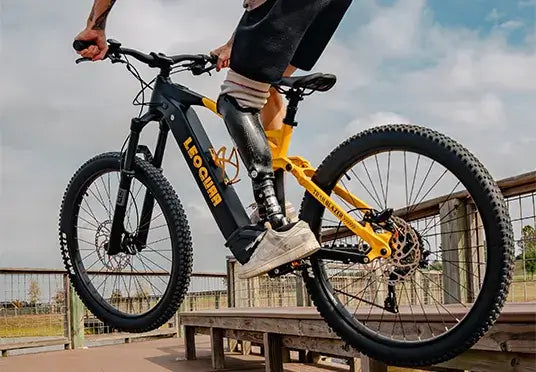
Found only on full-suspension e-bikes, the rear shock is a smaller, separate unit that manages impacts on the rear wheel. It's built into the frame's pivot system, allowing the rear wheel to move independently of the main frame. A rear shock works together with the front fork to provide the ultimate level of comfort and control, keeping both wheels planted on the ground over seriously rough and technical terrain.
This is the standard for electric mountain bikes (eMTBs).
Suspension Seatposts
A suspension seatpost is a simpler, more affordable way to add comfort. It replaces a standard, rigid seatpost and has a small amount of built-in suspension travel, typically using a spring or rubber part. While it won't improve traction or control like a suspension fork, it does an excellent job of absorbing small vibrations and sharp hits that would otherwise travel up through the saddle.
It's a popular upgrade for commuters and recreational riders who want to take the edge off a harsh ride without the complexity of a full suspension system. It is also worth remembering that comfort does not come from the fork alone. Real-world vibration testing from CyclingAbout shows that suspension components and tire setup work together, and that the right comfort-focused parts can produce noticeable, even double-digit, changes in vibration reduction. That is why a rigid or short-travel ebike fork can still feel much better when the rest of the bike is set up intelligently.
Types of eBike Forks
The ebike fork is the heart of your bike's comfort and control. The technology inside the fork determines how it feels, how much it costs, and how you maintain it. There are three main categories you'll encounter: coil, air, and rigid.
Understanding the differences is key to making an informed decision.
Rigid vs Suspension Ebike Forks: Which One Makes More Sense?
If your priority is low maintenance, lighter weight, and efficient riding on smooth roads, rigid ebike forks make more sense. They are simple, quiet, and ideal for riders who do not regularly hit rough surfaces.
If your priority is comfort, better control, and less fatigue on imperfect roads, a suspension fork is the better option. It helps absorb repeated impacts that would otherwise travel straight into your hands and shoulders.
The simple answer is this. Rigid forks are best for smooth pavement and minimal upkeep. Suspension forks are best for rougher streets, gravel paths, and riders who value comfort over absolute simplicity.
That trade-off is consistent across most real-world fork comparisons. VTUVIA notes that rigid forks stay lighter and simpler for smooth pavement, while suspension forks do a better job on uneven city roads and mixed terrain where comfort and control matter more. For many riders, the right choice comes down to whether efficiency or bump absorption matters more on the routes they ride most often.

Coil Suspension Forks
A coil fork uses a steel spring to absorb impacts. It's a simple, proven, and reliable technology. The spring compresses when you hit a bump and then expands back to its original length.
Most entry-level to mid-range e-bikes come equipped with coil forks due to their durability and cost-effectiveness.
Pros: Very durable and requires minimal maintenance. They are excellent at smoothing out small, chattery bumps, providing a "plush" feel right from the start of the travel.
The lower price point makes them accessible.
Cons: They are much heavier than air forks. Adjustability is often limited to a "preload" dial, which tightens the spring but doesn't change the spring rate, making it difficult to tune for specific rider weights.
Air Suspension Forks
An air fork uses a chamber of pressurized air as its spring. By adding or removing air with a special high-pressure "shock pump," you can precisely tune the fork's stiffness to match your exact body weight and riding style.
This technology is standard on mid-range to high-end e-bikes, especially eMTBs.
Pros: Much lighter than coil forks. They are highly adjustable, allowing a 150-pound rider and a 250-pound rider to achieve the perfect setup on the same fork.
They often offer more advanced adjustments like rebound and compression damping.
Cons: They are more expensive and require more maintenance. You'll need to check the air pressure regularly to ensure it's correct, and they require more frequent internal servicing (like seal and oil changes) to maintain peak performance.
Rigid Forks
A rigid fork has no suspension mechanism at all. It is a solid, single-piece part, usually made from aluminum, steel, or carbon fiber, that connects the front wheel directly to the frame.
You'll find these on some urban, road, and fitness-focused e-bikes where low weight and pedaling efficiency are the top priorities.
Pros: Extremely lightweight, completely maintenance-free, and offers maximum power transfer from your pedals to the road, as no energy is lost to suspension movement.
Cons: Offers zero shock absorption. Every crack, bump, and imperfection in the road is transferred directly to your hands and arms, leading to a harsh and tiring ride on anything but perfectly smooth pavement.
| Feature | Coil Fork | Air Fork | Rigid Fork |
|---|---|---|---|
| Mechanism | Steel Spring | Pressurized Air Chamber | Solid, No Moving Parts |
| Rider Experience | Smooth on small bumps, consistent feel | Highly tunable, progressive feel | Harsh, direct connection to road |
| Best For | Commuting, recreational riding, budget-conscious buyers | eMTB, performance riders, varying terrain | Smooth pavement, fitness, minimalists |
| Price Point | Low to Mid | Mid to High | Low |
| Maintenance Level | Low (occasional cleaning/lubing) | Medium (regular pressure checks, periodic service) | None |
Choosing the Right Suspension
With the technical basics covered, let's get to the most important question: which suspension system is right for you? The answer depends entirely on where and how you ride.
We've broken it down into three common rider profiles to help you match the technology to your needs.
City and Urban Commuters
Your Terrain: You primarily ride on paved roads, bike lanes, and city streets. Your main obstacles aren't massive drops, but rather jarring potholes, cracked pavement, manhole covers, and the occasional curb.
Comfort and reliability are your top priorities. Our Recommendation: For this environment, a short-travel ebike fork with 60mm to 100mm of travel is ideal. A quality coil fork is often more than sufficient, providing durable, set-and-forget performance that smooths out the worst of the urban landscape. For most city riders, the best ebike fork is not the most expensive one. It is usually a short-travel fork that stays comfortable, reliable, and easy to live with every day.
An entry-level air fork can offer a more refined and tunable ride if your budget allows. Alternatively, a rigid fork paired with a high-quality suspension seatpost is an excellent and cost-effective combination.
This setup keeps the front end light and efficient while protecting your body from sharp jolts through the saddle.
Trail and eMTB Riders
Your Terrain: You live for dirt trails, singletrack, and challenging landscapes. Your rides involve navigating roots, rocks, drops, and steep descents.
Control, traction, and the ability to handle big impacts are non-negotiable.
Our Recommendation: This is where a high-performance, e-bike-specific air suspension fork is essential. Look for forks with 120mm to 170mm of travel.
The adjustability of an air spring is critical for setting up the bike for aggressive riding and varying trail conditions. For this category, you should also be considering a full-suspension e-bike.
The combination of a capable front fork and a rear shock is what allows an eMTB to maintain traction and control over technical terrain, giving you the confidence to ride faster and safer.
All-Round Recreational Riders
Your Terrain: You are the versatile rider. Your weekend might include a paved bike path, a packed gravel trail, a cruise through the park, and some bumpy backroads. You need a system that can handle a bit of everything without being overly specialized.
Our Recommendation: A mid-travel (100mm-120mm) suspension fork is your sweet spot. Both coil and air forks are excellent choices here.
A good coil fork offers reliable comfort across mixed surfaces. An air fork provides a significant upgrade in terms of tunability and lower weight, which you'll appreciate on longer rides with varied elevation.
For this rider, a "hardtail" e-bike (with front suspension only) often provides the perfect balance of comfort, efficiency, and value.
Key Features to Look For
When comparing e-bike forks or looking at the spec sheet of a new e-bike, you'll encounter a few key terms. Understanding what they mean will help you figure out what you're actually getting.
Suspension Travel
Travel refers to the maximum distance the fork can compress. It's measured in millimeters (mm).
More travel means the fork can absorb bigger impacts.
- 60-100mm: Common on hybrid and commuter e-bikes. Ideal for smoothing out city streets and light trails.
- 100-130mm: Found on all-around or "trail" e-bikes. A versatile amount of travel for mixed-surface riding.
- 140-180mm: Standard for electric mountain bikes (eMTBs). Designed for aggressive off-road riding, absorbing large drops and rocks.
Adjustments
Beyond the spring type, forks have dampers that control the speed of movement.
Preload: This adjustment adds tension to the spring (coil or air). It's used to set the "sag," which is how much the suspension compresses under just your body weight. Correct sag ensures the fork is in the ideal part of its travel to absorb both bumps and dips.
Rebound: This controls how quickly the fork extends back to its full length after being compressed. Too fast, and the bike will feel like a pogo stick. Too slow, and the fork won't recover in time for the next bump, "packing down" and feeling harsh.
Lockout: This is a switch or lever that temporarily makes the suspension rigid. It's useful for long, smooth climbs on pavement to prevent the fork from bobbing and wasting your energy.
What Fork Travel and Setup Work Best for Everyday Riding?
For most commuters and mixed-surface riders, 80mm to 100mm of fork travel is enough. It smooths out potholes, curb edges, and rough pavement without making the front end feel too tall or too soft. If your routes include more gravel, broken roads, or light trail sections, 120mm can add comfort and confidence.
A 100mm vs 120mm fork on an ebike usually comes down to terrain. Choose 100mm for city efficiency and predictable steering. Choose 120mm if your riding is rougher and you want more forgiveness from the front end.
Setup matters too. Start by setting sag so the fork compresses slightly under your body weight. A good starting point for most riders is about 25 to 30 percent sag relative to total fork travel. Surface 604 recommends using that range as a practical baseline, then adjusting rebound so the fork returns quickly without feeling jumpy or uncontrolled. That gives most ebike forks a balanced feel before you fine-tune for terrain and rider preference. Then adjust rebound so the fork returns quickly but does not bounce back abruptly. In most cases, a simple and balanced setup will feel better than running the fork too soft.
Stanchion Diameter
Stanchions are the smooth upper tubes of the fork that the lower legs slide on. Their diameter is a key indicator of a fork's stiffness.
For heavier, faster e-bikes, a thicker stanchion is crucial for precise steering and durability. A typical cross-country fork might have 32mm stanchions, while a robust eMTB fork will have 36mm, 38mm, or even 40mm stanchions to resist flexing under heavy braking and cornering forces.
Axle Type
This is what secures your wheel to the fork.
Quick Release (QR): The traditional, thinner skewer with a lever on one end. It's common on entry-level bikes but is less stiff.
Thru-Axle: A larger diameter axle that threads directly into the fork. It creates a much stiffer and safer connection between the wheel and the fork, vastly improving steering precision.
For any e-bike intended for off-road use, a thru-axle is a must-have feature.
Can You Upgrade Your Ebike Fork? Yes, but Fit Comes First
In many cases, you can upgrade from a rigid fork to a suspension ebike fork, or replace a basic fork with a better one. The key is compatibility. A fork upgrade only works well if the new fork matches your frame and wheel setup.
Before buying, check four things first. Confirm the steerer tube type and diameter, axle standard, wheel size, and brake mount. Then compare axle-to-crown height so the new fork does not change your bike’s front-end geometry too much.
The bottom line is clear. An ebike fork upgrade can improve comfort and control, but only if the fork actually fits your frame and keeps the handling balanced.
Simple eBike Fork Maintenance
You don't need to be a professional mechanic to keep your suspension fork working well. A little bit of regular care goes a long way in preserving its performance and lifespan.
Regular Cleaning
The most important maintenance task is the simplest. After every ride, especially if it was wet or dusty, take a clean, soft rag and wipe down the exposed stanchions.
This removes dirt and grime that can get pulled past the dust seals and damage the fork's internals over time. Never use a high-pressure washer, as it can force water past the seals.
Check Your Settings
If you have an air fork, get in the habit of checking the air pressure every few weeks with your shock pump. Temperature changes and slow leaks can cause the pressure to drop, making the fork feel too soft.
It only takes a minute and ensures your fork is always performing as it should. Also, pay attention to how the rebound feels and make small adjustments if needed.
Know When to See a Pro
Suspension forks have internal oil and seals that wear out over time. Just like your car, they need periodic service.
As a general rule, a fork should have a basic "lower leg service" (new dust seals and splash oil) about once a year or every 50 hours of riding. A full damper service is typically recommended every 100-200 hours.
This professional service is the best way to ensure your fork remains smooth, safe, and durable for its entire life.
Conclusion
The suspension system, and particularly the ebike fork, is far more than just a comfort feature. It is a critical performance part that dictates your bike's safety, control, and overall ride quality.
By understanding the basic differences between coil, air, and rigid forks, you can cut through the marketing jargon and identify the technology that truly matches your riding style. Whether you're choosing your first e-bike or considering an upgrade, focus on your primary use.
A city commuter has vastly different needs than an aggressive trail rider. By matching the fork's travel, features, and type to your terrain, you empower yourself to make a confident choice. Investing in the right suspension is an investment in a better, more enjoyable, and more capable electric bike experience.
Frequently Asked Questions
Q: How much suspension travel do I need for commuting?
A: For city commuting and paved roads, 60-100mm of travel is ideal. This provides enough cushioning for potholes and rough pavement without adding unnecessary weight or complexity to your ride.
Q: What's the difference between coil and air suspension forks?
A: Coil forks use a steel spring and are more durable with less maintenance, but they're heavier and less adjustable. Air forks use pressurized air, making them lighter and highly adjustable, but they require more maintenance and cost more.
Q: How often should I service my ebike fork?
A: Basic cleaning after every ride is essential. For air forks, check pressure every few weeks. Professional service should be done annually or every 50 hours for basic service, and every 100-200 hours for full damper service.
Q: Can I upgrade my rigid fork to a suspension fork?
A: In many cases, yes, but it depends on your bike's frame design and headtube specifications. You'll need to ensure the new fork has the correct steerer tube diameter, axle type, and doesn't change your bike's geometry too drastically.
Q: Is full suspension necessary for electric mountain biking?
A: While not absolutely necessary, full suspension (front and rear) is highly recommended for aggressive trail riding and technical terrain. It provides better traction, control, and comfort when riding over rocks, roots, and drops at higher e-bike speeds.


Leave a comment