
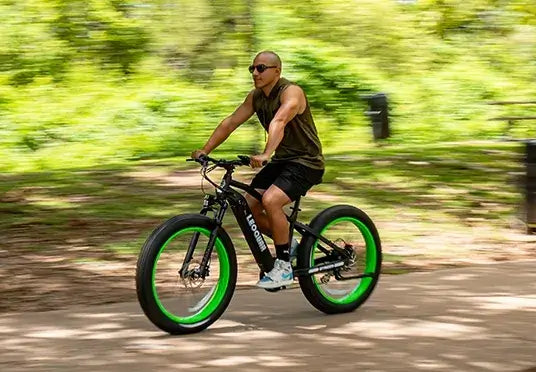




Electric Bike With Fat Tires: How Far Can You Ride On One Charge?
The Quick Answer
So, how far can you really ride an electric bike with fat tires on one charge? Let's cut to the chase. For most riders on a typical model, you can expect a range of 25 to 50 miles (40-80 km). This number isn't pulled from a hat; it's a real-world benchmark based on average conditions.
Think of a rider of average weight, using a medium level of pedal assist, and riding mixed terrain that includes some small hills and flat sections. This estimate provides a solid starting point, but as you'll soon discover, your actual mileage will vary. The number on the box is just the beginning of the story.
The General Benchmark
To understand that 25-50 mile figure, we need to look at the hardware. Most popular fat tire e-bikes come equipped with a 48V 15Ah battery, which translates to a capacity of 720 Watt-hours (Wh). This battery is typically paired with a powerful 750W hub motor. It's this common combination of battery "fuel" and motor "engine" that produces our benchmark range. Now, let's break down the seven key factors that can either stretch that range to its maximum or cut it short.
Unpacking "It Depends"
The true answer to the range question is always "it depends." Your electric bike with fat tires is a complex system, and its performance is influenced by a dynamic mix of variables. Understanding these factors empowers you to predict your range more accurately and even extend it. Here are the seven most critical elements that dictate how far you'll go.
1. Battery Capacity
Think of your battery's capacity as the size of your vehicle's fuel tank. The bigger the tank, the farther you can go. The most accurate measure of this capacity is Watt-hours (Wh). It's calculated by multiplying the battery's Voltage (V) by its Amp-hours (Ah). Don't just look at Volts; Watt-hours tell the whole story. For a more detailed breakdown, you can review a clear explanation of Watt-hours.
- 500Wh Battery: Often found on lighter or more budget-friendly models, expect a lower-end range of 20-40 miles.
- 720Wh Battery: The common standard, delivering that core 25-50 mile range.
- 960Wh+ Battery: Found on premium, long-range models, capable of pushing past 60 miles or more under ideal conditions.
2. Assist Level and Throttle Use
Your Pedal Assist System (PAS) level is like the throttle on a motorcycle. Each level up doesn't just add a little more power; it often increases power consumption exponentially. Riding in PAS level 1 might sip energy, while PAS level 5 will guzzle it. Furthermore, relying on a throttle provides instant power without pedaling, but it's the fastest way to drain your battery. Using the throttle is like flooring the gas pedal. It's great for quick starts or tough hills, but sustained use will slash your maximum range.
3. Terrain and Elevation
Riding on a smooth, flat bike path is the e bike fat tire equivalent of highway driving—it's incredibly efficient. The moment you introduce hills or challenging surfaces, your motor has to work much harder, drawing significantly more power. Climbing a steep hill requires a huge amount of torque and energy. Similarly, riding an electric bike with fat tires on soft surfaces like sand, snow, or thick mud creates immense drag, forcing the motor into overdrive just to maintain momentum.
4. Total Weight
The physics are simple: it takes more energy to move more mass. This total weight includes the rider, the bike itself, and any cargo you're carrying (groceries, gear, a child seat). A 250-pound rider will get less range than a 150-pound rider on the exact same bike under the exact same conditions. Fat tire e-bikes are also inherently heavier than their standard-tire counterparts, which already puts them at a slight disadvantage in the range game from the start.
5. Tire Pressure and Profile
This is a crucial and often overlooked factor, especially for fat tires. The key concept here is rolling resistance—the force your tires have to overcome to roll across a surface. You can learn more about how rolling resistance works from tire experts. There is a fundamental trade-off:
- Lower Pressure: Creates a larger contact patch with the ground. This is fantastic for grip and comfort on trails, sand, or snow.
However, on pavement, it dramatically increases rolling resistance and reduces your range. - Higher Pressure: Reduces the contact patch, leading to much lower rolling resistance on smooth surfaces. This maximizes your range on roads but results in a bumpier ride and less traction on loose terrain.
6. Riding Style and Cadence
Are you a smooth, steady rider or an aggressive one? Constant hard accelerations and sudden stops use far more battery than maintaining a consistent speed. Every time you accelerate from a stop, the motor draws a large peak of power. Your cadence, or the speed at which you pedal, also matters.
Most e-bike motors have an optimal RPM range where they operate most efficiently. Pedaling along with the motor at a steady, comfortable cadence (typically 70-90 RPM) helps it stay in this sweet spot, conserving energy. "Ghost pedaling" (pedaling too slowly) or mashing on the pedals forces the motor to do all the work inefficiently.
7. External Conditions
Never underestimate Mother Nature. Riding into a strong headwind is like riding up a constant, invisible hill. Your motor has to fight that resistance every inch of the way, which can reduce your range by 20% or more. Cold temperatures also have a significant impact.
Lithium-ion batteries perform best in mild weather. When the temperature drops towards freezing, the chemical reactions inside the battery slow down, temporarily reducing its effective capacity and power output. A battery that gives you 40 miles in summer might only give you 30 miles in the winter.
| Factor | Impact on Range | Degree of Impact |
|---|---|---|
| High Battery Capacity | Increases | High |
| High PAS Level / Throttle Use | Decreases | High |
| Hilly / Soft Terrain | Decreases | High |
| High Total Weight | Decreases | Medium |
| Low Tire Pressure (on Pavement) | Decreases | Medium |
| Aggressive Riding Style | Decreases | Medium |
| Headwind / Cold Weather | Decreases | Medium-High |
The Fat Tire Factor
We've discussed general e-bike factors, but what about the fat tires themselves? Why does choosing an electric bike with fat tires specifically impact your range? It comes down to a core trade-off between go-anywhere capability and pure efficiency.
Stability vs. Efficiency
The number one reason we choose fat tires is for their incredible stability, traction, and comfort. Those wide, cushioned tires act as passive suspension, smoothing out bumps and giving you the confidence to ride over sand, snow, and gnarly trails where a standard tire would sink or slip. However, this capability comes at a cost. Two of the range-reducing factors we discussed—weight and rolling resistance—are significantly amplified by fat tires.
The tires and wheels are heavier, and their massive contact patch creates more friction, especially on hard surfaces. You are trading some maximum potential range for the freedom to ride virtually anywhere.
A Head-to-Head Comparison
To visualize this, let's compare a typical electric bike with fat tires to a standard commuter e-bike.
| Feature | Fat Tire E-Bike | Standard Commuter E-Bike |
|---|---|---|
| Tire Width | 4.0" - 5.0" | 1.75" - 2.2" |
| Typical Pavement Pressure | 15-25 PSI | 40-65 PSI |
| Rolling Resistance (Pavement) | High | Low |
| Bike Weight | High (70-85 lbs) | Medium (50-65 lbs) |
| Comfort / Shock Absorption | Excellent | Good |
| Ideal Terrain | All-Terrain: Sand, Snow, Trails, Pavement | Pavement, Light Gravel |
The Verdict on Range
What does this all mean for your ride? It means an electric bike with fat tires is a master of versatility, not a specialist in range maximization. While a commuter e-bike might squeeze out an extra 10-15 miles on a perfect day on pavement, it would be left behind the moment the trail gets muddy or the beach calls. As noted in reviews of popular models, these bikes are celebrated for their rugged, all-terrain performance. You are choosing a machine that prioritizes adventure over absolute efficiency.
Real-World Scenarios
Theory is one thing, but seeing how these factors play out in the real world makes it all click. Let's take a 720Wh electric bike with fat tires and put it through three common scenarios.
1. The Daily Urban Commute
- The Ride: A 10-mile round trip to the office. The route is mostly flat, paved roads with a few gentle inclines and about 15 stoplights.
- The Settings: You keep the tire pressure high (20-25 PSI) for efficiency. You use PAS 2 for cruising and bump it to PAS 3 for hills and accelerating from stops. You barely touch the throttle.
- The Experience: The ride is smooth and effortless. The fat tires soak up potholes and uneven pavement. You're not trying to break any speed records, just maintain a steady pace.
- The Result: You arrive back home with approximately 70-75% of your battery remaining. At this rate, you could easily make this commute for three or four days before needing a charge, achieving a total potential range of around 45 miles.
2. The Weekend Trail Adventure
- The Ride: A 20-mile loop through a state park. The terrain is a mix of packed dirt, loose gravel, and several long, steep climbs.
- The Settings: You drop the tire pressure to 15 PSI for better grip and cushioning. You're frequently using PAS 3 and 4 to power up hills and navigate technical sections. You use the throttle in short bursts to get over tough roots and rocks.
- The Experience: The bike feels like a tank, confidently rolling over everything in its path. On the climbs, you can feel the motor working hard, and you're pedaling consistently to help it along. The battery indicator seems to drop much faster than it did on your commute.
- The Result: You finish the 20-mile ride with about 25% battery left. Your total estimated range in these conditions is around 27 miles.
3. The Beach or Snow Ride
- The Ride: A fun cruise along the packed sand at the shoreline or on a groomed snowmobile trail.
- The Settings: Tire pressure is dropped to an ultra-low 8-10 PSI to "float" on top of the soft surface. You have to use PAS 3 or higher constantly just to keep moving, as the rolling resistance is immense.
- The Experience: It's a unique and thrilling experience, but you're watching the battery percentage tick down in real-time. The motor is running almost constantly to fight the drag of the sand or snow. Every foot of progress requires a significant power draw.
- The Result: After just 15 miles, your low battery warning light comes on. In these extreme "range killer" conditions, your total range might be limited to 15-20 miles, if that.
How to Maximize Your Range
Now that you understand what affects your range, you can take active steps to extend it. A few small adjustments to your bike and riding habits can add precious miles to every charge.
Before You Ride
Check Tire Pressure: This is the easiest and most impactful adjustment. Inflate your tires to the higher end of their recommended PSI for road riding. Let air out for off-road traction. Reduce Weight: Don't carry unnecessary cargo. If you have a heavy lock or bag you don't need for a specific trip, leave it at home. Charge Smart: Charge your battery fully before a long ride. Store your battery indoors in a temperature-controlled environment, especially during very hot or cold weather.
During Your Ride
- Use Lower PAS Levels: Challenge yourself to ride in the lowest assist level you're comfortable with. Think of higher levels as a "boost" for hills, not a default setting.
- Limit the Throttle: Use the throttle sparingly. It's a tool for acceleration and tough spots, not a cruise control. Pedaling is always more efficient.
- Maintain a Smooth Cadence: Pedal smoothly and consistently. Help the motor by finding a gear that allows you to maintain a steady pedaling speed. Avoid mashing on the pedals in a high gear.
- Ride Smoothly: Look ahead and anticipate stops. Coasting to a red light is more efficient than braking hard at the last second.
After Your Ride
- Battery Care: Don't leave your battery fully discharged for long periods. It's best to store it with a partial charge (between 40% and 80%) if you won't be riding for a while.
- Keep It Clean: A clean drivetrain (chain, gears) runs more efficiently than a gritty, dirty one. Regular maintenance reduces friction and saves energy.

Range Is in Your Control
Ultimately, the range of your fat tire electric bike is not a fixed number. It's a dynamic result of your choices, your environment, and your bike's setup. While a typical range of 25-50 miles is a great starting point, you are the pilot. By understanding the factors at play—from battery size and assist levels to tire pressure and terrain—you gain control. You learn when to conserve energy for a long journey and when to unleash the power for a thrilling climb. Embrace the versatility, manage the variables, and enjoy the freedom to ride farther.
Frequently Asked Questions
How long does it take to charge a fat tire e-bike battery?
Most fat tire e-bike batteries take 4-6 hours to charge completely from empty. A 720Wh battery with a standard 2-amp charger typically needs about 5 hours for a full charge. Some fast chargers can reduce this to 3-4 hours, but slower charging is generally better for battery longevity.
Can I ride a fat tire e-bike without using the motor?
Yes, you can ride any e bike fat tire without motor assistance, but it will be more challenging than a regular bike. Fat tire e-bikes are heavier (70-85 lbs) and have more rolling resistance, making pedaling without assistance a good workout. The motor can be turned off completely to save battery or get exercise.
What happens if my battery dies during a ride?
If your battery dies, your electric bike with fat tires becomes a regular bike that you can still pedal home. However, it will be significantly heavier and harder to pedal than a standard bicycle. Always plan your route with some battery reserve, and consider the return trip when calculating your range needs.
Do fat tires require special maintenance compared to regular e-bike tires?
Fat tires don't require special maintenance, but they do need regular pressure checks since they operate at much lower PSI (8-25) than regular tires. Check pressure weekly, as even small leaks are more noticeable at low pressures. The larger volume also means punctures might be less frequent, but repairs require more time due to the tire size.
Can I upgrade my fat tire e-bike battery for longer range?
Many fat tire e-bikes allow battery upgrades, but compatibility is crucial. Check your bike's voltage requirements and mounting system before buying a larger capacity battery. Some bikes also support dual battery setups. A bigger battery will add weight but can significantly extend your range - a 960Wh battery instead of 720Wh could add 10-20 miles to your typical ride.


Leave a comment