



EBike vs ATV for Hunting: Which Is Better in 2026?
Isn't it a pain to have to take your noisy quad back on a trailer just for a short morning hunt? When you're going alone and all you need is a daypack, an e-bike is generally the better choice. With an e-bike, you're able to move smoothly along narrow deer trails that a large ATV can't access, won't disturb the entire forest, and can park right up in your hallway when you've finished. On the other hand, we do know that an e-bike isn't suitable for all situations; if you're hauling a wall tent setup, driving through deep clay, or removing a large bull elk, you'll still need a heavy quad behind you.
Your decision should be based on the specific terrain and workload you have rather than on the specifications listed on paper. If you want to avoid regret after making the purchase, ask yourself these three practical questions: What vehicles are actually permitted to use your local tracks? How much weight do you really need to carry at one time? And will your present setup be sufficient to get the machine into the woods?
E-Bike vs ATV Benefits at a Glance
On quiet tracks, on narrow trails, when it comes to storage, and for short solo journeys, an e-bike generally wins. An ATV, on the other hand, is usually the better choice when four-wheel stability, more cargo space, or frequent heavy recovery work is required.
|
Hunting need |
E-bike advantage |
ATV advantage |
|
Quiet approach |
Fewer noise sources and a smaller trail presence |
Better parked farther from the final approach |
|
Narrow routes |
Easier to steer, turn, walk, or reposition |
Needs more width and turning room |
|
Heavy hauling |
Handles rider and gear within the bike's stated limit |
Better suited to larger loads and recovery work |
|
Deep mud and ruts |
Wide tires help, but you still have to balance |
Four wheels and more ground clearance can help |
|
Home storage |
Fits in many garages and sheds |
Usually needs more floor space |
|
Routine upkeep |
Charging, tires, brakes, and drivetrain care |
Fuel, oil, filters, tires, and engine service |
|
Trailhead transport |
Needs an e-bike-rated rack or truck space |
Often needs a truck bed or trailer |
Quiet E-Bike Benefits Near Your Stand
The biggest e-bike benefit often shows up during the last mile to your stand. You can ride at a controlled pace without a gas engine idling under you. The bike isn't silent, though. Knobby tires, a dry chain, loose buckles, and a rattling rack can still give you away.
An e-bike is just as easy to stop and walk through a narrow area. When you come across a fallen branch or have to turn around on a narrow path, you're working with a bicycle, not a four-wheeled vehicle.
It is important to carry out battery planning since factors such as hills, cold air, soft ground, the weight of the cargo, and the use of a high level of assistance can all reduce the distance you can travel. For instance, the Leoguar Fastron SO is equipped with a 720Wh removable battery and has an advertised pedal-assist range of up to 60 miles; however, that figure does not guarantee that the bike will last for a hunting trip with a load. You should test the route yourself and leave a margin for return travel.
ATV Benefits for Heavy Hunting Work
It's more reasonable to use an ATV when the job is greater than the approach. For example, when you need camp supplies, recovery equipment, or a pack-out that would exceed the weight limit stated for an e-bike. The four wheels also eliminate the slow-speed balancing that is required when riding a loaded bicycle.
But you still need to check the exact owner's manual. Payload, rack capacity, towing limits, tire pressure, and passenger rules vary by model. The U.S. Consumer Product Safety Commission recommends a helmet, eye protection, boots, gloves, long pants, and other protective gear when riding an ATV.
The ability to work will also come with a greater amount of equipment, such as a trailer, tie-downs, fuel storage, garage space, registration, and a service plan. However, if your only trips are short ones undertaken alone on roads that have been properly maintained, you might end up paying for capacity that you rarely use.
E-Bike and ATV Access Comes First
Don't assume an e-bike can use every bicycle trail. And don't assume a quiet electric motor makes it non-motorized under every land agency's rules.
The Bureau of Land Management says e-bikes can use many motorized areas and OHV trails. Local BLM managers may also authorize certain e-bike classes on selected non-motorized routes, but the national rule doesn't automatically open those routes. U.S. Forest Service maps can list e-bikes and ATVs separately as well.
Before a hunt, check:
- The current motor vehicle or travel-management map
- The e-bike class allowed on the exact route
- Seasonal closures and ATV width limits
- Wildlife-area and game-retrieval rules
- ·Written private-land permission
Terrain Changes the E-Bike vs ATV Choice
On dry two-track and firm dirt roads which are crowded, either machine can be used. However, the answer differs when the track becomes narrow, steep, soft, or badly rutted.
An e-bike requires more from you: you have to balance the bike, select a path, brake using two points of contact, and at times you must pedal even when carrying loads. Although wide tires can be helpful on soft ground, they won't turn deep mud into pavement.
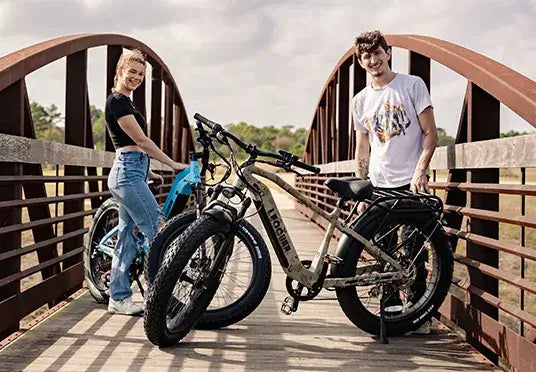
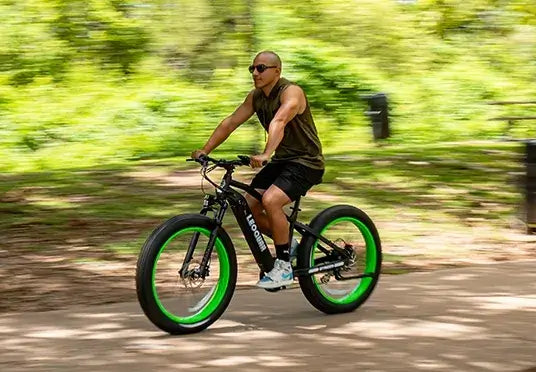
The Fastron SO uses 26 x 4.0-inch tires, a 750W-rated rear hub motor with up to 85Nm of torque, and Tektro hydraulic brakes with 180mm rotors. Its total weight limit is 300 pounds, including you and your cargo.
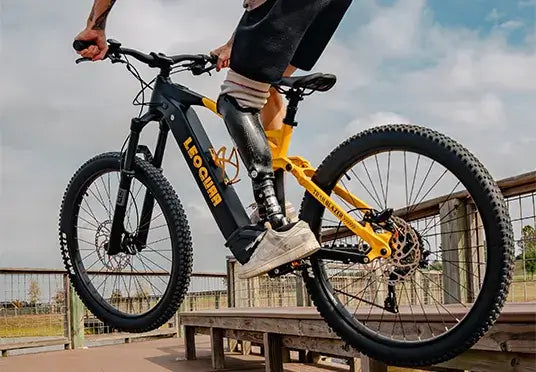
For roots, rocks, and longer technical climbs, the Leoguar Trailblazer takes a different approach. It uses a 500W-rated mid-drive motor with up to 100Nm of torque, a Shimano 10-speed drivetrain, RockShox full suspension, and four-piston hydraulic brakes. Its total payload limit is 275 pounds.
Those figures help you compare bikes, but they don't create a towing rating. If a product page or manual doesn't state trailer compatibility and towing limits, ask Leoguar support before adding one.

E-Bike vs ATV Ownership Costs
Then the other items, then the purchase price. On an e-bike budget, you’ll need an e-bike-rated vehicle rack, cargo bags, safety equipment, tire tools, brake pads, chain care, and indoor battery storage. Depending on your ATV budget, you might need a trailer or truck setup, fuel containers, permits, oil, filters, a winch, and more storage space.
Electricity is just one minor aspect of owning an e-bike; tires, brake pads, chains, cassettes, batteries, and workshop labor still have to be paid for. Neither is ATV ownership limited to gasoline alone. You should use the service schedule and local fees applicable to the specific model you are looking at.
If price is driving your choice, Leoguar's hunting e-bike guide under $2,500 covers the bike-buying side in more detail. Keep transport and accessories in a separate line of your budget. They're easy to forget at checkout.
Match the E-Bike to Your Hunt
When you usually ride on rolling dirt, loose gravel, or soft ground, the Fastron SO comes with fat tires, a total weight limit of 300 pounds, and a removable 720Wh battery; the rear rack and basket are optional, and the stated capacity of the rear basket is 55 pounds.
The Trailblazer comes with a mid-drive motor, full suspension, four-piston brakes, and a 10-speed drivetrain if your route involves roots, rocks, and technical climbs. Although it is more expensive and has a lower stated payload capacity, it is a trail-oriented bike that places a focus on control rather than on carrying cargo.
Use total weight, not motor wattage, as your first filter. Add your body weight, clothing, pack, water, mounted accessories, and everything carried on the bike. Compare the current options in Leoguar's electric-bike collection.
Your E-Bike vs ATV Verdict
When you are mostly hunting by yourself, place a priority on a quieter approach, make use of narrow legal paths, and are able to keep the total weight within the bike's stated weight limits, then go for an e-bike. It is easier to store and can be used for riding on trails outside of the hunting season.
An ATV should be chosen if heavy hauling is a regular feature of the job, if your route allows ATVs, and if you have the truck, trailer, storage space, and a service budget to back it up.
It is possible for some hunters to use both types of vehicles. The ATV is suitable for carrying out camp duties and for legal off-road transport, while the e-bike takes care of the last quiet approach. However, before purchasing two machines, it's important to study the map since access is the priority.
FAQs About E-Bikes and ATVs
Is an e-bike worth it if I own an ATV?
It can be if your ATV gets you close but not quietly through the final narrow section. Map that section first. If your e-bike class isn't allowed there, buying one won't solve the problem.
Which Leoguar fits flat hunting roads?
The Fastron SO suits packed roads and loose mixed surfaces with 26 x 4.0-inch tires, a 720Wh removable battery, and a 300-pound total limit. Stay within its surface, fit, and load limits.
Which Leoguar handles technical climbs?
The Trailblazer is the closer fit because its mid-drive motor works through a 10-speed drivetrain and supplies up to 100Nm of torque. Its 275-pound limit includes you and everything carried on the bike.


Leave a comment