





Electric Folding Bike vs Electric Folding Scooter: 5-Mile Test
The Short Answer
Here's the bottom line for riders in a hurry. The winner in the electric folding bike vs electric folding scooter debate depends on your trip and what matters most to you after a 5-mile journey. There is no single champion—but for most 5-mile urban commutes, the electric folding bike proves to be the more complete, long-term solution.
The electric folding bike is the clear winner for rides with hills, bumpy roads, or for riders who want a more comfortable ride with the option of light exercise. Over a daily commute, those factors tend to matter more than saving a few pounds when carrying the vehicle. It offers better comfort, stability, and can handle more situations. The electric folding scooter takes the crown for trips on smooth, flat roads where you need ultimate portability. It's built for easy, last-mile travel when you need to carry it onto a train or store it under a desk.
The rest of this guide will break down exactly why, using a real-world commute scenario.
Quick-Look Winner's Circle
* Bike Wins For: Bike Wins For: Ride Comfort, Hill Climbing, Exercise, Rough Surfaces, Cargo Capacity.
* Scooter Wins For: Scooter Wins For: Portability, Ease of Use, Last-Mile Transit, Compact Storage Footprint.
The 5-Mile Challenge
Let's simulate a typical 5-mile urban commute to truly understand the difference. We'll compare both vehicles head-to-head at every stage of the journey.
The Starting Line
It all begins with getting out the door. The electric folding scooter is the quicker option when getting out the door in a hurry. However, for most commuters, carrying the bike is an occasional task, while riding it is a daily one. Grabbing a 30 lb scooter is like carrying a heavy briefcase. You can unfold it in seconds, and carrying it down stairs is easy. The electric folding bike requires more muscle. Most folding e-bikes weigh between 45 and 65 pounds, while many popular commuter scooters fall in the 28 to 40-pound range.
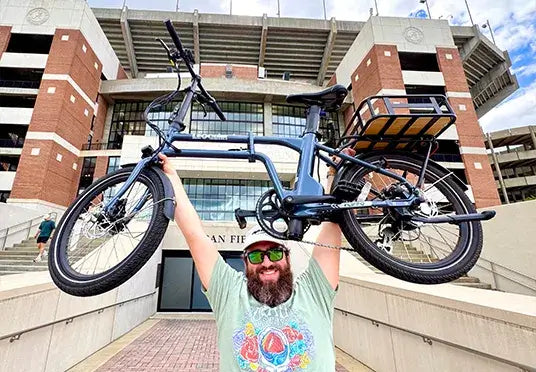
Managing a 50 lb folded ebike can feel like handling awkward luggage, especially on narrow stairs. The unfolding process is also slightly more involved, with frame hinges, handlebar clamps, and seat adjustments.

The Journey Itself
Once you're on the road, the experience changes significantly. On an electric folding bike, the ride is defined by comfort, stability, and predictability. Its larger wheels, typically 16-20 inches, roll over cracks, small potholes, and uneven pavement with ease.
A seated position is naturally more stable and noticeably less tiring over a 5-mile distance. Over time, that stability translates into better control and confidence in real-world traffic. For major bumps, you can stand on the pedals to absorb the shock. As many real-world user discussions highlight, riders often report feeling more secure and less tired on a bike for any trip longer than a mile or two. By comparison, an electric folding scooter delivers a noticeably harsher ride. Its smaller 8-10 inch wheels transmit every vibration from the road.
Unless you invest in a model with a quality suspension system, you will feel every crack. The standing posture can also lead to foot and leg fatigue as the miles add up. When it comes to effort, the choice is clear. The ebike pedal-assist system allows you to fine-tune your level of effort, from minimal assistance to a light workout. That flexibility makes longer rides easier to sustain without fatigue. The scooter is a pure twist-and-go experience, getting you to your destination with zero physical effort.
Finally, let's talk hills. An electric folding bike, with its combination of gears and a motor, conquers inclines with relative ease. A scooter, relying solely on its motor, will often slow down significantly on steep hills and is best suited for flat terrain.
The Finish Line
You've arrived. Now what? This is where the scooter reclaims its advantage.
An electric folding scooter is the portability champion. It folds down into a slim, pole-like shape that is incredibly easy to manage. You can slide it under your office desk, tuck it into a gym locker, or hold it between your legs on a crowded bus. This is its single biggest selling point.
An electric folding bike, while foldable, remains a relatively bulky object by comparison. For riders who don’t need to carry their vehicle daily, this trade-off is often acceptable. It collapses into a chunky cube that takes up considerable floor space. While it fits under some desks, it's far less discreet. Bringing it onto a packed train during rush hour can be a challenge, and as even the most compact folding e-bikes show, their folded size and weight can still be an obstacle for daily multi-modal commuters.
Spec Sheet Showdown
For those who prefer hard data, this table breaks down the key differences at a glance.
| Feature | Electric Folding Bike | Electric Folding Scooter | The 5-Mile Winner Is... |
|---|---|---|---|
| Average Weight | 45-65 lbs (20-30 kg) | 28-40 lbs (13-18 kg) | Scooter (for carrying) |
| Ride Comfort | Good to Excellent (larger wheels, seated) | Fair to Good (depends on suspension) | Bike (for ride quality) |
| Hill Climbing | Excellent (gears + motor) | Fair to Poor (motor only) | Bike |
| Typical Range | 20-50+ miles | 15-30 miles | Bike (though both are sufficient for 5 miles) |
| Folded Size | Bulky cube/rectangle | Slim, compact pole | Scooter |
| Legality | Generally treated as bicycles | Varies widely by city/state | Bike (often simpler regulations) |
| Fitness Benefit | Yes (pedal-assist) | No (fully motorized) | Bike |
| Maintenance | More complex (chain, gears, tires) | Simpler (fewer moving parts) | Scooter |
A note on legality: Bicycle laws are fairly standardized. Scooter laws are not. In some areas they are considered motor vehicles, in others they are banned from sidewalks, and in some, the law is still unclear. Always check your local rules, as regulations can vary significantly.
Beyond the 5-Mile Commute
Your decision shouldn't be based on a single trip. Consider your entire lifestyle.
The Weekend Explorer: Here, the best folding ebike with torque sensor is the only real option. Its superior range, comfort, and all-terrain capability make it perfect for exploring park paths and light trails. A scooter is almost exclusively confined to pavement.
The Errand Runner: Need to pick up a few groceries or carry a gym bag? A folding bike, which often has options for racks and panniers, can act as a mini cargo vehicle. A scooter offers virtually zero cargo capacity beyond what you can carry in a backpack.
The Apartment Dweller: This is a tough trade-off. A scooter's slim, vertical storage profile is a massive advantage in a tiny apartment. However, for many city dwellers, a folding e-bike is the only kind of bike they can realistically own without a garage.
The Folding vs. Non-Folding Choice
This brings us to a crucial point: the folding electric bike vs electric bike debate. Choosing a folding model is always a compromise. You are prioritizing portability over peak performance.
For the same price, a non-folding electric bike will almost always give you a better ride, a larger battery, a stronger frame, and bigger wheels. But if you don't have the space to store it, those benefits are irrelevant. The folding feature is what makes bike ownership possible for many urbanites.
The Cost Factor
What about the impact on your wallet?
- Upfront Cost: Generally, electric folding scooters have a lower entry price. You can find reliable commuter models for under $600, while quality electric folding bikes typically start around $1,000 and go up quickly from there.
- Long-Term Costs: Here, the scooter maintains an edge. It has fewer moving parts. There is no chain to clean, no gears to adjust, and no derailleurs to break. Maintenance is mostly limited to tires and brakes.
A folding e-bike carries all the maintenance needs of a regular bicycle—chain care, gear tuning, brake adjustments—plus the complexity of the electric system. While both are cheaper than a car or public transit pass over time, the scooter will likely be the more budget-friendly option to own.

The Final Verdict
So, after 5 miles and beyond, which device wins? It's not about which is better, but which is better for you.
You should buy an electric folding bike if:
* Your commute includes hills or rough roads.
* Comfort during the ride is your top priority.
* You want to incorporate light exercise into your day.
* You plan to use it for weekend recreation or carrying small loads.
* You have a bit more storage space and can handle a heavier vehicle.
You should buy an electric folding scooter if:
* Your commute is mostly flat and on smooth pavement.
* Ultimate portability is your number one concern.
* You need to frequently combine your ride with public transport.
* You live in a small apartment with very limited storage.
* You want a completely effortless, sweat-free ride.
By evaluating your daily route, storage situation, and lifestyle, you can confidently choose the portable electric vehicle that will truly improve your urban mobility.
Frequently Asked Questions
1. Which is better for a multi-modal commute involving a train or bus?
For commuters combining their ride with public transit, the electric folding scooter is almost always the better choice. Its lighter weight and significantly smaller folded size make it far easier to carry on and off crowded trains and buses without disturbing other passengers.
2. Can I get a good workout on an electric folding bike?
Absolutely. The pedal-assist system allows you to choose your level of support. You can set it to a low level for a moderate workout or turn it off completely to ride it like a traditional bike. It's an excellent way to integrate physical activity into your commute.
3. Are electric scooters or folding e-bikes easier to maintain?
Electric scooters are significantly easier to maintain. They lack a chain, gears, and derailleur, which are the most common maintenance points on a bicycle. Scooter maintenance is typically limited to checking tire pressure, brake adjustments, and ensuring all bolts are tight.
4. How do weather conditions affect both vehicles?
Electric folding bikes generally handle weather better due to their larger wheels and more stable riding position. In rain or snow, the seated position and better traction give bikes an advantage. Electric scooters can be more challenging to control in wet conditions due to smaller wheels and standing position.
5. What's the typical battery life and charging time for each?
Electric folding bikes usually have larger batteries that last 20-50 miles and take 4-6 hours to charge fully. Electric folding scooters typically offer 15-30 miles of range with 3-5 hour charging times. Both should easily handle a 5-mile commute, but bikes generally offer more range for longer trips.


Leave a comment