



What Electric Bike Has the Longest Range - or Just the Biggest Battery?
The answer to “what electric bike has the longest range” keeps changing. Some high-end electric bikes claim a range of more than 200 miles. But the model with the biggest number is not always the real “range king.” What matters more is the gap between the range a brand claims and how far the bike can actually go in real riding conditions.
In order to answer the question at once, current contenders for the absolute maximum distance are models such as the hand-built Optibike R22 Everest, which has a large 3,260Wh battery, or the Fiido Titan, which has an optional triple-battery arrangement, though these are extreme examples that most riders will never need.
In real-life situations, even the most efficient long-range e-bikes usually manage a range of 50 to 120 miles on a single charge, the exact figure depending on the terrain, the rider's weight, and the assist mode used. Although it is possible to achieve ranges of 150 miles or more with a dual-battery system, the majority of high-quality models end up in this mid-range range—providing a good distance without calling for excessive complexity or cost.
The guide will explain the real factors which determine an e-bike's range—namely battery watt-hours, motor efficiency, the type of terrain and the way you ride—enough to enable you to find the right e-bike that meets your genuine requirements.
Today's Longest-Range E-bikes
The following shows the market leaders in claimed maximum range. It is important to bear in mind that these figures are generally obtained under ideal, laboratory conditions—specifically by using the lowest pedal assist level setting on level ground with a light rider. A great many of these e-bikes rely on optional and usually costly battery upgrades in order to reach their maximum ranges. As Bicycling.com states in its thorough e-bike reviews, it is essential to understand specifications such as battery Watt-hours (Wh) if one is to make sense of these claims.
The brands most often mentioned when it comes to exceptional range are Optibike, Riese & Müller, and Tern; their models designed for touring usually have a dual-battery setup and mid-drive motors that are geared towards endurance. These bicycles are built not only to claim the top spot in terms of range but also with real-world performance on long journeys in mind.
| Model Name | Claimed Max Range (Miles) | Battery System | Bike Type | Key Consideration |
|---|---|---|---|---|
| Optibike R22 Everest | ~300 | Single 3,260Wh | Mountain | Hand-built, premium price, extreme performance. |
| Fiido Titan | ~250 | Triple-battery option (up to 1,420Wh) | Cargo / Utility | Max range requires purchasing two extra batteries. |
| Lectric XPedition | ~150 | Dual-battery option (1,248Wh total) | Cargo | An accessible and popular dual-battery cargo choice. |
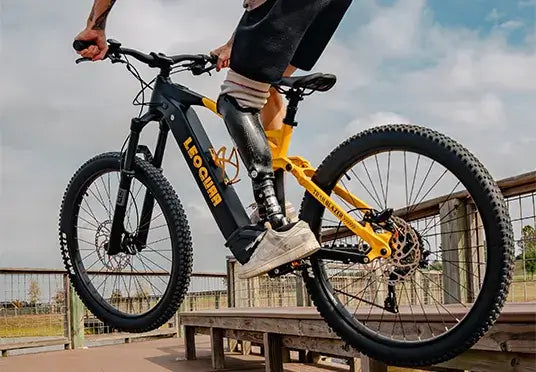
| Leoguar Trailblazer Mid-Drive EMTB | Up to 100 | Single 720Wh | Trail / EMTB | Relies on mid-drive efficiency rather than a large battery. |
Beyond The Hype
The figure given on the box almost never is equal to the range you'll actually achieve. It's similar to a car's miles per gallon (MPG) rating in that it's a standard figure, not a guarantee you'll get those exact figures each time you use the vehicle. Your real-world mileage will differ a great deal because of a variety of factors which manufacturers are unable to take into account during their standard tests. The key to becoming a knowledgeable e-bike buyer and owner is to understand these factors. It's important to realise, before believing any range figure, that the battery capacity alone does not determine the range—other factors such as the way you ride, the place you ride, and the amount you carry often have an even greater impact.
Here are the primary factors that impact your real-world range:
The greater the mass of the rider and the cargo, the more energy is required to move that mass. A rider who weighs 220 pounds will therefore have a shorter range than one who weighs 150 pounds, and putting 50 pounds of groceries on a cargo bike will use up the battery more quickly.
The terrain is the main cause of battery consumption for the majority of riders since each hill causes the motor to have to work a great deal harder and therefore use up a large amount of energy in a short period of time; a ride involving a gain in elevation of 1,000 feet will use much more battery than one that is 20 miles long and lies along a river path.
Level of assistance: This is the most direct influence you have on your battery usage. Although riding in 'Turbo' or 'Boost' mode may be exciting, it can easily reduce your maximum range by more than 50% when compared to using 'Eco' or 'Tour' mode.
Tires and pressure: Tires that are knobby and run at low pressure give good traction and comfort yet have a great deal of rolling resistance, which drains your battery; in contrast, smoother and higher-pressure commuter tyres are much more efficient and will greatly increase your range.
The weather conditions mean that fighting a strong headwind is similar to riding up a hill since it causes the engine to have to work harder if you want to keep your speed. Also, cold temperatures have a direct chemical impact on the way batteries perform and this results in a reduced capacity. It is by no means uncommon for the effective capacity of a lithium-ion battery to be lowered by 20 to 30 per cent in freezing weather.
The way you ride involves making more use of energy when you frequently stop and start, as happens in city traffic, than when you keep a constant speed on an open road. Unlike gradual and steady application of power, aggressive acceleration drains the battery a lot more quickly.
Real-world tests carried out on touring e-bikes have shown that reviewers always note a large difference between the mileage that is claimed and that which is actually achieved. A high-end touring bike which claims to go 250 km (155 miles) may in reality cover only 100 to 120 km (62 to 75 miles) when touring under normal conditions and carrying luggage on varied terrain.
Anatomy of a Long-Range System
A genuine long-range e-bike goes beyond possessing a large battery; it is an efficient and well-balanced system in which all the parts function seamlessly in order to make the most of every watt of energy stored in the battery pack. Rather than posing the question 'which electric bike has the longest range', we should be asking 'what factors contribute to an efficient long-range system that actually works in the real world?'
Battery Capacity and Quality
The most important figure when it comes to the electric bike battery size is Watt-hours (Wh), since this figure shows the total energy capacity of the battery—that is, its "fuel tank" capacity and thus how far you could potentially travel. Do not get confused by the voltage (V) or the amp-hours (Ah) that are given separately.
The correct way of working out capacity is by using this simple formula: Volts (V) multiplied by Amp-hours (Ah) gives Watt-hours (Wh). A typical e-bike has a 500Wh battery, whereas long-range models usually begin at 750Wh and increase from there. As you can observe when comparing 750Wh and 1000Wh batteries, the extra 250Wh can correspond to an additional 10 to 20 miles of real-world range. Apart from size, the quality of the battery is important for long-term performance and reliability. Cells made by well-known manufacturers such as Samsung, LG, and Panasonic generally retain their charge better, last through more charge cycles, and deliver a more even power output throughout their lifespan.
Motor Efficiency
You cannot say that all motors are equally efficient, particularly when long-distance touring is involved in hilly regions, since mid-drive motors are usually seen as more efficient than hub motors. The reason for this is that they drive the crank and thus can make use of the bike's gears to remain within their optimal power band. This enables the motor to work within its best RPM (revolutions per minute) range, just as a car's engine does when running at its most efficient speed. On a steep incline it is more efficient because you can change into a lower gear, which keeps the motor spinning comfortably without it overheating or drawing too much current from the battery.
Hub motors that are powerful and situated in the centre of either the front or rear wheel are generally simpler and cheaper than other options for ordinary commuting requirements. They work very well on routes that are level but may be less efficient when climbing over long distances since they have a fixed gear ratio. According to an analysis carried out by Cycling Electric, high-end touring bikes usually combine a large-capacity battery with an efficient mid-drive motor made by companies such as Bosch, Shimano, or Brose in order to get the greatest range.
The Power of Two
At the moment, the most straightforward method that manufacturers are using to increase the range is to use dual-battery systems. They achieve this by adding a second battery, which in effect doubles the bike's Watt-hours and allows the total capacity to reach 1250Wh, 1500Wh, or even higher without having to completely redesign the motor or the frame.
The approach taken by accessible cargo bikes such as the Lectric XPedition and by extended range models such as the Fiido Titan is that it offers a huge gain in potential range, enabling journeys of more than 100 miles under ideal conditions. The drawbacks, on the other hand, are a considerable increase in the total weight of the bike, greater complexity in the electrical system, and a higher price which could mean the cost is doubled.
It is up to your own riding habits whether or not this compromise is worthwhile; if the rides you usually take are longer than 50 miles or if you are carrying a heavy load, a dual-battery system can give you a sense of security and more flexibility. However, in the case of shorter trips or when riding casually on weekends, the extra cost and weight might mostly go unutilized.
The Overlooked Heroes
Other parts also have a vital supportive function in terms of increasing the range. It is important for the drivetrain to have a broad gear range, in particular when it comes to a mid-drive system, since this gives both the rider and the motor more possibilities of keeping an efficient cadence. A few bikes are equipped with regenerative braking, which makes use of the motor to slow the bike down and returns a small amount of energy to the battery while going downhill. Although this is an interesting technological feature, we consider its actual effect on the total range to be generally negligible for most e-bikes and it usually contributes only a few percentage points at most.
How to Maximize Your Range
Whatever e-bike you have, you can increase the distance you get from each charge by adopting wiser riding habits. The advice given is entirely free and can sometimes make a greater difference than a small battery upgrade which could cost hundreds of dollars.
Act smoothly when using your power. Imagine yourself as a professional driver who wants to get the best fuel economy. Don't make sudden, sharp starts from stationary position since this causes the engine to operate at full power. Instead, apply power in a gradual manner so that the engine works in cooperation with you rather than doing all the work on its own. Most important of all, use the lowest level of assistance that you feel at ease with for the type of terrain you are riding. "Eco" mode is your best option if you want to cover the greatest distance, and "Turbo" mode should only be used when you really need it, for example when going down a steep hill.
Take control of your gears. When your e-bike is equipped with gears, rather than relying entirely on the motor, make use of them! A lot of new e-bike riders err by keeping the bike in a high gear and then asking the motor to make up for their bad gear choice. In order to pedal as efficiently as possible, you should shift into different gears so that you maintain a steady and comfortable pedalling rate (about 70 to 90 RPM) which feels natural. Instead, shift into a lower gear before you begin an ascent, not only when you're already halfway up and having to struggle.
Look after your bike. A bike that has been properly maintained will be more efficient and will give you improved range and performance. The simplest and most effective thing you can do is to frequently check your tyre pressure and make sure the tyres are inflated to the recommended PSI which is printed on the side of the tyre. Having low tyre pressure causes drag and acts as a quiet battery killer by possibly reducing your range by 20% or more. Moreover, you should keep your chain clean and lubricated in order to reduce the friction in the drivetrain that would otherwise waste energy.
Work out a more efficient route. When range is the most important factor for a particular journey, use a mapping app that is specialised for cycling, such as Komoot or the cycling layer on Google Maps, to locate routes that will avoid major hills if at all possible. A route that is slightly longer but level will almost always consume less battery than a shorter, more hilly one which requires constant climbing.
Look after your battery and it will last longer and will retain its capacity more effectively over time. If you're storing it for a long time, don't leave it at a full charge (100%) or at a completely empty charge (0%) since both situations put a strain on the cells. The best approach for long-term storage is to keep the battery at a charge level between 40% and 80% in a cool, dry place, away from severe temperatures.
During a recent charity ride that covered a distance of 70 miles, we discovered that the riders who had the most battery left at the end were not those using the most expensive bikes with the largest batteries. Rather, they were the ones who used lower assist modes on level terrain, shifted gears wisely before going up a hill, and maintained a smooth and steady speed rather than constantly speeding up and slowing down. This showed that good riding technique can easily provide an extra 10 to 15 miles of range compared to an aggressive riding style which opposes the bike's natural efficiency.

Finding the Right Range For You
In the end, the question of which "e-bike with the longest range" isn't really about one particular model coming out on top, but rather about identifying the correct mix of a battery that is large enough, an efficient system, and good riding habits that suit your real needs. Having the largest battery doesn't always make the best choice for all riders; a very large 1500Wh dual-battery setup does add a considerable amount of weight and cost, which might not be necessary for your usual rides and could in fact make the bike less pleasant to use.
Before making a purchase, evaluate your own riding habits and requirements in a realistic way. Is a range of 150 miles truly necessary if all you do is make a 10-mile daily commute, or are you intending to go on multi-day unsupported tours throughout the state where there are few opportunities to charge? In most cases, a battery with a capacity between 500Wh and 750Wh offers more than adequate range for everyday errands and long weekend trips without having to pay the extra weight and cost associated with batteries that have an extreme range. For instance, if your primary purpose is commuting each day, a range of 40 to 60 miles is generally enough—even when using a moderate level of pedal assist and having to climb some hills. On the other hand, e-bikes that are designed for multi-day tours usually aim for a range of 80 to 150 miles or more, particularly when carrying luggage or riding in remote areas with limited charging facilities.
Using this information, you will be able to ignore the marketing claims and select an e-bike that provides the real-world range that you really need, thus securing plenty of happy miles in the future without having to spend a lot of money. When you're buying within a strict budget, our guide applies these same principles to particular models.
Frequently Asked Questions
Which electric bike currently on the market has the greatest range?
The Optibike R22 Everest is currently the one with the record, featuring a claimed range of about 300 miles due to its large 3,260Wh battery. The bike, however, is hand-built, premium and has an extremely high price which most riders do not need.
What range can I realistically expect from my e-bike?
The real-world range you can achieve on most e-bikes that have batteries of 500 to 750Wh will vary between 25 and 50 miles according to the terrain, your weight, the level of assistance used, and the weather. Under ordinary riding conditions, you should expect to get about 50 to 70 percent of the range claimed by the manufacturer.
Is the extra cost of dual-battery e-bikes justified?
Dual-battery systems can almost double your range but at the same time increase both weight and cost; they are worthwhile if you frequently ride long distances of over 50 miles or use your bike for carrying cargo, but are unnecessary for most regular commuting requirements.
What is the most important factor in maximizing the range of an e-bike?
The greatest effect on range is achieved by using lower assist settings such as 'Eco' mode; you can generally double your distance by remaining in these lower assist modes and reserving 'Turbo' mode only when you really need it, for example, when going up hills or facing a headwind.
How does cold weather affect e-bike battery range?
Cold temperatures might reduce lithium-ion battery capacity by 20-30% in freezing weather. The chemical reactions inside the battery slow down in cold conditions, reducing both power output and total range until the battery warms up.


Leave a comment