




eBike or Onewheel? Which Is Better for Daily Use in 2026?
For most people who need a reliable way to get around every day in 2026, an eBike is the better choice. A Onewheel works great as a small, fun device for entertainment and quick trips. That's the simple answer to the ebike vs onewheel debate.
This guide will explain exactly why this is true, helping you decide which personal electric vehicle fits your lifestyle, daily travel, and needs best. We'll skip the marketing talk and look at how these two popular options actually perform in real life. We will look at the important factors: usefulness, distance, safety, cost, and of course, how fun they are.
Here's what we'll cover:
- Practicality: Which vehicle can truly replace a car for daily errands?
- Performance: How do range, speed, and hill-climbing capabilities compare?
- Portability vs. Utility: The core trade-off between carrying your ride and your ride carrying your stuff.
- Long-Term Cost: A look beyond the sticker price to the true cost of ownership over three years.
At-a-Glance Comparison
For those who want a quick summary, this table breaks down the basic differences between a typical commuter eBike and a Onewheel.
| Feature | eBike | Onewheel |
|---|---|---|
| Best For | Daily commuting, errands, exercise | "Last-mile" travel, recreation, pure fun |
| Learning Curve | Low (if you can ride a bike) | High (requires balance and practice) |
| Typical Range | 30-70 miles (50-110 km) | 12-32 miles (19-51 km) |
| Cargo Capacity | High (racks, panniers, baskets) | Low (limited to a backpack) |
| Weather Resistance | Good (with fenders and proper care) | Poor (not recommended in wet conditions) |
| Portability/Storage | Low (requires bike rack/secure parking) | High (fits under a desk or in a car trunk) |
| Maintenance | Standard bike maintenance (brakes, chain) | Specialized (tire changes, potential electronics) |
Daily Use Practicality
When the new feeling goes away and a vehicle has to work every single day, being practical becomes the most important thing. This is where the eBike builds a huge lead for most users.

Commuting Range and Speed
An eBike is made for long distances. Many commuter e-bikes easily go 50+ miles on one charge, which removes the "range worry" that bothers users of smaller personal electric vehicles. This means you can handle a long trip to work, run errands after work, and try a new route home without always checking your battery level. On the other hand, even expensive Onewheels often max out around 30-35 miles under perfect conditions, making them better for shorter trips in a neighborhood rather than travel across a city. The onewheel vs ebike range difference is a key factor for daily commuters.
Carrying Cargo
This is a clear win for the eBike. The ability to add bags, front or rear racks, and baskets turns an eBike into a real utility vehicle. We can carry laptops, a change of clothes, a gym bag, and a full load of groceries easily.
Our direct experience shows this difference clearly. On an eBike, we simply attached our bag loaded with groceries onto the rear rack, and the weight was barely noticeable while riding. Trying the same thing on a Onewheel was completely different. Riding with an unbalanced grocery bag messed up our center of gravity, requiring intense focus and making the ride feel dangerous. Anything more than a well-balanced backpack is a challenge.
Tackling Hills
An eBike's combination of a powerful motor and traditional bicycle gears makes climbing hills easy. You can spin up a steep hill without breaking a sweat, keeping speed and stability. A Onewheel can handle hills, but it demands more rider skill to manage balance and puts serious strain on the motor and battery. A steep, long climb on a Onewheel will drain your battery at a scary rate, drastically reducing your total range.
Riding in Bad Weather
The world isn't always sunny and 75 degrees. For a true daily driver, all-weather ability is a must. The eBike, with its two large wheels, natural stability, and options for full-coverage fenders, is far better in rain and wind. Its electronics are generally better protected from bad weather. Onewheels, with their exposed wheel and grip tape deck, are generally not recommended for use in wet conditions, as water can damage the electronics and create dangerously slippery surfaces. As with any vehicle, proper care is important, and we agree with expert advice from cycling publications that electirc bike regular maintenance is crucial, especially after riding in bad weather.
Onewheel's Unique Appeal
To be clear, the Onewheel isn't trying to be an eBike. Its strengths are in areas where an eBike can't compete: an amazing ride feel and incredible portability.
The "Float" Sensation
This is the Onewheel's magic. There is simply no other feeling in the world of personal electric vehicles like floating over pavement, carving smooth turns as if you're snowboarding on asphalt. It's natural, engaging, and deeply satisfying. An eBike ride is efficient and comfortable, but a Onewheel ride is an experience. This is its main selling point and something an eBike cannot copy. It aligns perfectly with the fun-focused design philosophy of Onewheel's creators, who focus on the feel of the ride as a core part of the product's DNA.
Ultimate "Last-Mile" Portability
If your commute involves multiple types of transport, such as taking a train and then heading to the office, the Onewheel can be a game-changer. Its compact size and built-in handle make it easy to carry, store, and move through crowded spaces. You can tuck it under your desk, bring it onto a busy train, or toss it in the trunk of a car without much planning. An e-bike, even a folding model, is usually larger and heavier.
- Onewheel: Weighs about 25–35 lbs. Compact enough to fit under a desk and easy to carry for short distances.
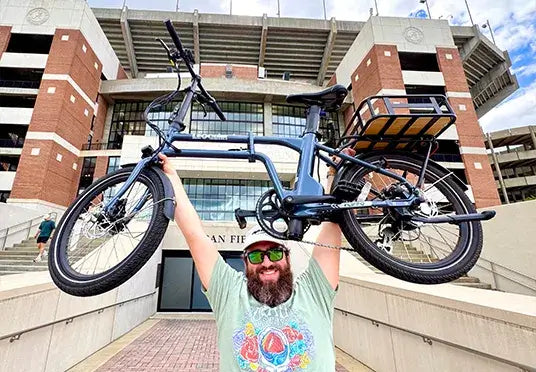
- Folding e-bike: More portable than a standard e-bike, but still bulkier at around 40–60 lbs. Better suited for riders who want comfort, stability, and seated riding.
- Standard e-bike: Not designed for frequent carrying. It usually requires a secure parking space, bike rack, or dedicated storage area.
For the true “last-mile” problem—getting from the transit stop to your final destination—the Onewheel is arguably one of the most elegant solutions available. Still, folding e-bikes are worth considering if your route includes longer stretches, rougher roads, or a need for more stability and everyday commuting comfort.
Safety and Legal Realities
When choosing a daily vehicle, safety and legality cannot be ignored. The differences between an eBike and a Onewheel in this area are significant.
The Learning Curve
The familiarity of a bicycle gives the eBike an immediate advantage. If you can ride a bike, you can ride an eBike. Our experience confirms this: within minutes of hopping on a new eBike, we were comfortably cruising.
The Onewheel requires a dedicated learning process. Our first hour was a series of wobbly starts, quick dismounts, and learning to trust the self-balancing technology. It takes practice and patience to build the muscle memory and confidence needed to ride smoothly and safely in many different conditions. Expect to spend several hours practicing in an empty parking lot before you're ready for the bike lane.
Stability and Crash Dynamics
Physics doesn't lie: two wheels are naturally more stable than one. An eBike's larger wheels and longer wheelbase make it far more forgiving of potholes, cracks, and unseen obstacles. Onewheel "nosedives"—sudden stops where the nose of the board drops to the ground—are a known risk, often caused by overpowering the motor, hitting an obstacle, or riding with a low battery. While experienced riders learn to respect the board's limits, the risk is always present. E-bike accidents are more often related to traffic and are similar to those involving traditional bicycles.
Local Laws and Regulations
The legal landscape for personal electric vehicles is complex and varies by city and state. However, eBikes are rapidly becoming standardized. Most areas have adopted a Class 1, 2, or 3 system, which clearly defines where and how you can ride. This legal clarity is a major advantage for daily commuters.
Onewheels often fall into a legal gray area. They may be classified as skateboards, motorized scooters, or not be classified at all, leading to uncertainty about where you can legally ride them. As we look toward 2026, it's crucial to acknowledge the rapidly evolving personal electric vehicle market and the changing regulations. We strongly advise checking your local city and state transportation laws before purchasing any personal electric vehicle.
True Cost of Ownership
The sticker price is just the start of your investment. To understand the full financial picture of the ebike vs onewheel choice, we've projected the estimated costs over a three-year period for a mid-range model of each.
| Cost Item | Mid-Range eBike | Mid-Range Onewheel |
|---|---|---|
| Initial Purchase Price | ~$2,000 | ~$2,200 |
| Essential Gear (Helmet/Lock) | ~$150 | ~$150 |
| Tire Replacements (3 Yrs) | ~$120 (2 tires) | ~$200 (1 tire x 2) |
| Brake/Drivetrain Service | ~$300 | $0 |
| Potential Battery Replacement | ~$600 | ~$500 |
| Estimated 3-Year Total | ~$3,170 | ~$3,050 |
While the initial totals appear close, the details matter. Onewheel tires are proprietary and more expensive to replace than standard e-bike tires. You will likely go through them faster due to the nature of the ride. An e-bike requires periodic brake pad replacements and drivetrain service (chain/sprocket wear), a cost Onewheel owners avoid. However, service for eBikes can often be done at any local bike shop, whereas a Onewheel may require shipping it to a certified technician due to Future Motion's patented technology, which can lead to more costly and time-consuming repairs. Over the long term, the accessibility and lower cost of standard bicycle components often make the eBike a more economical choice for a high-mileage daily driver.
A Practical Folding eBike Option for City Riders
If the Onewheel appeals to you because of its small footprint, but you still want the comfort and confidence of a traditional bike, a folding eBike can be the better compromise. The Leoguar Flippo Folding Ebike is a good example of that middle ground. It is built for riders who need compact storage without giving up daily commuting range, seated comfort, or predictable handling.
With a 55 lb frame including the battery, Flippo is not as easy to carry as a Onewheel, but its folding design makes it much easier to store in an apartment, office corner, car trunk, or shared garage than a standard eBike. Its 48V 10Ah, 480Wh battery supports up to 45 miles of range, while the 350W motor, 7-speed gearing, and torque sensor help make stop-and-go city riding feel smoother and more controlled. For riders who worry about range, balance, storage space, or carrying groceries on a board-style device, Flippo solves those pain points in a more familiar bike format.

The Final Verdict
The choice between an ebike vs onewheel for your life in 2026 comes down to a single question: what is its primary purpose? Is it a tool for transportation or a toy for recreation?
Choose an eBike if:
- You need a reliable daily commuter for trips over 3-5 miles.
- You need to carry items like a laptop, gym bag, or groceries.
- You value stability, safety, and all-weather usability.
- You prefer a familiar, easy-to-learn mode of transport that can be serviced locally.
Choose a Onewheel if:
- Your top priority is fun and a unique, engaging riding experience.
- Your "commute" is a short "last-mile" solution from a transit hub or parking lot.
- You need maximum portability to carry your device into buildings or onto public transport.
- You have the time and dedication to master a new skill and accept the associated risks.

For the daily grind—the commutes, the errands, the real-world transportation needs—the eBike is the clear, practical, and more versatile winner. For the weekend thrill and ultimate portability, the Onewheel offers a feeling of "float" that is truly in a class of its own.
FAQ
Q: Can I ride a Onewheel in the rain?
A: No, Onewheels are not recommended for wet conditions. Water can damage the electronics and make the grip tape dangerously slippery. eBikes handle rain much better with proper fenders and care.
Q: How long does it take to learn to ride a Onewheel?
A: Most people need several hours of practice in a safe area before they feel confident. Expect to spend time in an empty parking lot learning balance and basic controls before riding in traffic or bike lanes.
Q: Which is faster, an eBike or Onewheel?
A: Most eBikes can reach 20-28 mph depending on their class, while Onewheels typically max out around 19-20 mph. However, eBikes maintain speed better on hills and over longer distances.
Q: Can I carry groceries on a Onewheel?
A: Carrying cargo on a Onewheel is very limited and challenging. You're basically restricted to what fits in a balanced backpack. eBikes can easily handle groceries, work bags, and other items with racks and panniers.
Q: Which costs more to maintain over time?
A: Both have similar total costs over three years, but the expenses are different. eBikes need brake service and chain maintenance but use standard bike parts. Onewheels need expensive proprietary tires and may require specialized repair services.


Leave a comment