



Bikes With Motors for Adults: Types, Uses and Key Differences
The New Age of Adult Mobility
The market for bikes with motors for adults is growing fast. These machines are no longer just a hobby for a few people, but they show a big change in how we get around. They make daily trips easier and let you ride longer for fun while giving you a gentle workout. This guide will help you understand the technology and pick the right bike for you, whether you want a pedal-assist electric bike, a strong off-road machine, or a classic gas-powered cruiser.
Types of Motorized Bikes
You need to understand the main types first. The term "bikes with motors for adults" includes many different kinds, and each has its own features and legal rules.
Electric Bikes (E-Bikes)
E-bikes are the most popular type because they help you pedal with an electric motor. The United States uses a class system to control their power and speed.
E-Bike Classifications
| Class | Top Assisted Speed | How it Works |
|---|---|---|
| Class 1 | 20 mph | The motor provides assistance only when you are pedaling (pedal-assist). There is no throttle. |
| Class 2 | 20 mph | Provides assistance when you pedal, but also includes a throttle that can power the bike without pedaling. |
| Class 3 | 28 mph | The motor assists only when you are pedaling, but up to a higher speed. It may or may not have a throttle that works up to 20 mph. |
Hub vs. Mid-Drive Motors
Where the motor sits makes a big difference in how the bike feels when you ride it.
- Hub Motors: These motors sit in the center of the front or rear wheel and are common, reliable, and cheap. They give you a feeling like something is pushing you from behind. Rear hub motors are used most often and give good grip on the road.
- Mid-Drive Motors: These motors sit where the pedals connect to the bike and send power straight to the chain and gears. This makes the bike feel more natural and balanced, and it works better on hills because the motor can use the bike's gears. You often find these on expensive electric mountain bikes and city bikes. Many mid-drive systems have a sensor that feels how hard you pedal and gives you the right amount of help.
Electric Motorcycles & Mopeds
This type sits somewhere between a bicycle and a motorcycle. These bikes have much stronger motors (2000W to 6000W or more) and go faster (30-50+ mph), and many don't have working pedals. They work with a throttle, and local laws often say you need a driver's license, registration, and insurance.
Gas-Powered Bicycles
This is the original motorized bicycle, and DIY fans still love it. You usually attach a small 2-stroke or 4-stroke engine kit to a regular bike frame. You can also buy "engine-ready" bicycles that have frames with built-in fuel tanks and motor mounts to make building easier. This choice needs mechanical skills and knowledge of local rules, which often treat them like mopeds.

Key Features to Consider
When you look at bikes with motors for adults, the specs tell you what really matters. Here are the important parts to check.
Motor Power (Watts & Torque)
Two key numbers define power:
Watts (W): This measures how much power the motor puts out. You'll see "nominal" (steady) and "peak" (maximum short-term) wattage. A 500W motor works fine for flat ground and lighter riders. A 750W motor is the standard and gives great performance for hills and carrying stuff. High-performance bikes can have 1000W, 1500W, or even two motors for extreme power.
Torque (Nm): This is measured in Newton-meters and shows the twisting force that gets you moving and helps you climb hills. Many brands don't advertise this number, but it's very important. A city bike might have 50-60 Nm, while a powerful all-terrain bike can have 90 Nm to 160 Nm for amazing climbing ability.
Battery and Range
The battery is like your gas tank. Its bike battery capacity is measured in Watt-hours (Wh), which you get by multiplying Volts (V) by Amp-hours (Ah). A bigger Wh number usually means you can ride farther.
A typical 48V 14Ah battery has 672Wh. You can expect to ride 30-60 miles on one charge in real conditions, but this changes a lot based on hills, your weight, wind, and how much help you use. Some long-range bikes with big or double batteries claim over 100 miles. Also think about whether you can remove the battery to charge it inside.
Frame and Payload Capacity
The frame is the bike's skeleton.
- Frame Style: A low step-thru frame is easy to use because you can get on and off easily, which is great for older riders, people with mobility limits, or city riding. A traditional high-step frame is stronger and often better for serious off-road riding. Folding frames are the best for storing in apartments or putting in a car trunk.
- Payload Capacity: This is the total weight the bike can safely hold, including you and any stuff you carry. Standard capacity is around 275-330 lbs. For heavier adults or people who plan to carry a lot (like groceries or a child seat), look for bikes with a strong frame that can handle 400 lbs or even up to 560 lbs.
Suspension and Comfort
Suspension smooths out bumps for a more comfortable and controlled ride.
- Front Suspension: A suspension fork is common and absorbs impacts from the front wheel, which you need for trails and rough city streets.
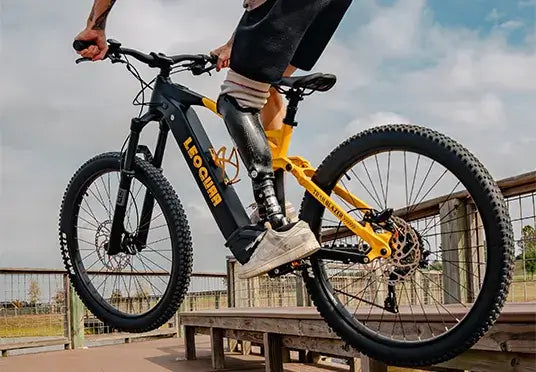
- Rear Suspension: This adds a shock absorber for the rear wheel, making a "full-suspension" bike. This is important for serious off-road riding and gives the best comfort for heavier riders or on bad roads.
- Other Comfort Features: Look for handlebars you can adjust for the right riding position, comfortable grips, and a wide, soft seat.
Tires and Brakes
Tires: Fat tires (usually 20" or 26" across and 4.0" wide) give great stability and grip on different surfaces like sand, snow, mud, and loose gravel. For city riding, narrower tires (2-2.5") work better and are easier to handle.
Brakes: With the extra weight and speed of a motor, you need powerful brakes. Mechanical disc brakes are the minimum, but hydraulic disc brakes are the best choice. They stop you better and are easier to control with less hand effort, which is a key safety feature on any quality electric bike for adults.
Matching a Bike to Your Lifestyle
The best bike is one that fits how you want to use it.
For the Daily Commuter
People who ride to work need a bike that works well and efficiently. A Class 3 e-bike (up to 28 mph) is a great choice for keeping up with city traffic. Key features include a realistic range of 40+ miles, built-in lights, fenders to keep you dry, and a back rack for carrying a laptop bag or groceries. A mid-drive motor with a torque sensor feels natural in stop-and-go traffic.
For the Off-Road Adventurer
Trail riders and backcountry explorers should focus on power and toughness. A full-suspension fat-tire bike is the best weapon for this job. Look for a high-torque motor (mid-drive or a powerful 1000W+ hub motor), strong hydraulic brakes, and a big battery. A tough frame that can handle at least 350 lbs can support a bigger rider plus camping gear.
For Heavy Adults
Riders over 250 lbs need a bike built for their needs. The most important thing is a high payload capacity (400 lbs or more) to keep the frame safe and strong. A powerful motor (750W minimum, 1000W recommended) is needed to give confident acceleration and hill-climbing without strain. Full suspension also helps a lot because it absorbs impacts that heavier riders feel more.
For Seniors and Accessibility
Comfort and ease of use matter most. A step-thru frame is the most important feature for easy getting on and off. An upright riding position puts less strain on your back and neck. A bike with a torque sensor gives smooth, predictable power that feels more like a regular bicycle. Look for a weight you can manage, especially if you need to put the bike on a car rack.
Understanding the Legal Landscape
Laws for bikes with motors for adults are very different by state and even city. Before you buy, research your local rules.
- E-Bikes: Learn how your area treats the three-class system. Some trails and bike paths may only allow Class 1 e-bikes.
- High-Power Bikes: Models that go beyond Class 3 definitions (like over 750W or faster than 28 mph on motor power alone) are often called mopeds or motorcycles and need registration, a license plate, and insurance. Not knowing the law is not a good excuse.
Top Brands and Models
The market has many excellent choices. Some brands focus on value, while others specialize in high-performance areas.
- All-Around Value: Brands like Rad Power Bikes, Lectric, and Leoguar offer many well-liked models that balance features and price, making them great starting points.
- High-Power and Off-Road: Companies like Himiway and Mokwheel are known for their tough, high-payload, and powerful fat-tire bikes designed for adventure.
- Premium and Specialty: Brands such as Pedego, Tern, and Ride1Up offer models with premium parts, innovative designs (like cargo bikes), and refined ride quality.
For more detailed comparisons and reviews across different categories, we recommend exploring resources like the annual "Best Electric Bikes" list from Bicycling Magazine, which provides in-depth testing and analysis.

Final Thoughts
Choosing a bike with a motor is an investment in your mobility and lifestyle. The key is to honestly think about what you mainly need. Don't focus on the highest possible speed or power if you mainly want to cruise relaxed on paved paths. On the other hand, don't save money on motor power and frame strength if you're a heavy rider or plan to tackle steep hills. By focusing on the main parts—motor, battery, frame, and brakes—and matching them to how you want to use the bike, you can confidently pick a motorized bike that will give you years of reliable service and fun.
Frequently Asked Questions
Q: How fast can bikes with motors for adults go?
A: Speed depends on the type and class of bike. Class 1 and 2 e-bikes assist up to 20 mph, Class 3 e-bikes assist up to 28 mph, while electric motorcycles and gas-powered bikes can reach 30-50+ mph depending on their motor power and local regulations.
Q: Do I need a license to ride a bike for adults with motor?
A: For most e-bikes (Class 1, 2, and 3), you don't need a license in most states. However, high-power bikes over 750W or those exceeding 28 mph may be classified as mopeds or motorcycles and require a driver's license, registration, and insurance.
Q: How far can I ride on a single battery charge?
A: Range varies from 30-60 miles for most e-bikes, depending on battery capacity (measured in Wh), terrain, rider weight, weather conditions, and assistance level used. Some high-capacity or dual-battery models can achieve over 100 miles per charge.
Q: What's the difference between hub motors and mid-drive motors?
A: Hub motors are located in the wheel hub and provide a "pushing" sensation, while mid-drive motors are positioned at the pedals and work through the bike's gears. Mid-drive motors offer more natural feel and better hill performance but are typically more expensive.
Q: How much weight can bikes with motors for adults carry?
A: Standard payload capacity ranges from 275-330 lbs, including rider and cargo. Heavy-duty models can support 400-560 lbs. Always check the manufacturer's payload specification to ensure the bike can safely handle your weight plus any gear you plan to carry.


Leave a comment