




Fastest Electric Bikes in 2026
The fastest electric bike most riders can legally use on public roads in the U.S. is usually a Class 3 ebike capped at 28 mph with pedal assist. For 2026, the smart buy isn't just the highest electric bike top speed claim, but the fast electric bike that can hold speed safely with the right torque, battery, brakes, certification, and legal setup.
| Best for | Pick | Why it fits | Who should skip it |
|---|---|---|---|
| Best utility value, not Class 3 | Leoguar Sprint Fat Tire Utility eBike | 350W motor, up to 55-mile range, fat tires, 3-in-1 rear mount, $1,050 entry price | Riders who specifically need 28 mph Class 3 assist |
| Best high-speed trail control | Leoguar Trailblazer Mid-Drive eMTB | MotiNova mid-drive feel, 720Wh battery, true 100-mile range, 2025 E-Dirty Cross eMTB win, $2,899 | Casual boardwalk riders or commuters who never leave pavement |
| Best compact city option | Leoguar Flippo Folding eBike | Folding frame, apartment and transit friendly, compact storage | Riders chasing the highest sustained speed on rough roads |
| Best all-terrain comfort | Leoguar Fastron SO or Fastron ST | 4-inch-plus fat tires, front suspension fork, step-over or step-through frame choice | Riders who care most about low weight and quick stair carrying |
| Best relaxed cruiser | Leoguar Zephyr SO or Zephyr ST | Upright position, beach cruiser comfort, full-bike UL certification | Speed-first riders who want a high speed ebike feel |
What Makes the Fastest Electric Bike Fast?

A fastest electric bike should be judged by legal assisted speed, acceleration, hill speed, sustained cruising speed, and stopping control. A 28 mph Class 3 ebike can feel quicker than an unlocked bike with weak torque if it accelerates cleanly, holds speed under load, and has brakes that match the pace.
That distinction matters because eBike speed gets messy fast. A product page may talk about peak motor watts, electric bike top speed, or off-road mode. Riders usually care about something simpler: Can it keep up with traffic on a bike lane? Can it climb without bogging down? Can it stop before the intersection?
For most U.S. buyers, the practical ceiling is Class 3. The PeopleForBikes E-Bike Legislative Toolkit centers the three-class system used by many states, with Class 3 assistance cutting off at 28 mph. Anything beyond that may need to be treated as a moped, motorcycle, private-property machine, or off-road-only setting, depending on where you ride.
So the best speed question is this: fast where?
On a paved commute, the Sprint makes sense because utility, fat-tire grip, cargo mounting, and price all matter in the same ride. It is not the Leoguar pick for 28 mph Class 3 riding. On dirt, the Trailblazer is the better speed tool because a mid-drive motor and race-proven trail geometry help you carry momentum through climbs, loose turns, and technical ground.
Fastest Electric Bike Picks by Rider Type
Best Utility Value, Not Class 3: Leoguar Sprint
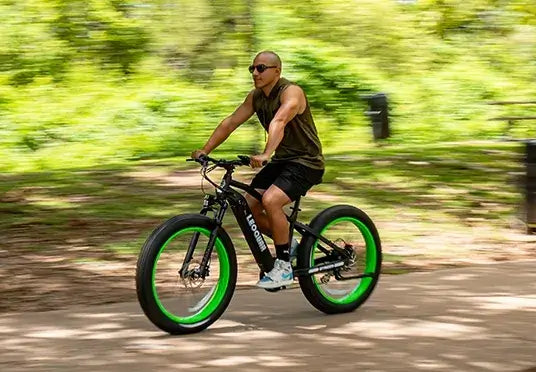
The Sprint is the Leoguar value anchor for riders who want a practical electric bike for daily life, not a fragile speed toy. It sits at the value end of the lineup at $1,050 with a 350W motor, up to 55 miles of range, oversized fat tires, and a 3-in-1 rear mount for cargo, a child seat, or gear bags.
That mix is more useful than a bare top-speed number for many shoppers. A commuter bike has to launch from stoplights, roll over broken pavement, handle grocery weight, and still feel settled at everyday utility speeds. Fat tires add rolling resistance, but they also give traction and confidence on wet pavement, gravel shoulders, and winter-stained roads.
The Sprint is a good fit if your route includes city streets, bike lanes, school drop-offs, errands, and weekend path rides. It is not the right pick if you want a bike that disappears under one arm on apartment stairs. It also deserves a local-law check, especially if your area limits throttle behavior differently from pedal assist.
For more city-focused options, compare Leoguar's commuter electric bikes.
Best High-Speed Trail Control: Leoguar Trailblazer
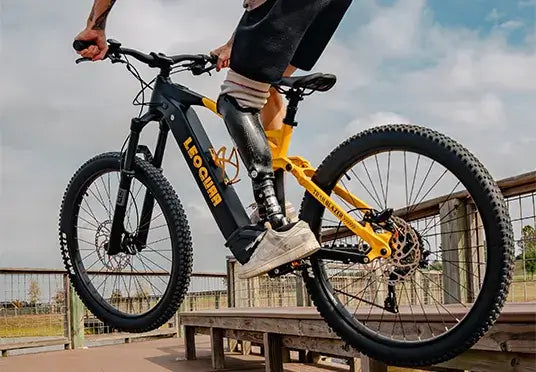
The Trailblazer is the faster choice when "fast" means carrying speed off-road. It uses a MotiNova mid-drive motor for a more natural pedaling feel, pairs it with a 720Wh battery, and claims a true 100-mile range. It also won 1st place at the 2025 E-Dirty Cross eMTB race, beating established motor brands in competition.
That race result matters because trails punish fake speed. A high speed ebike that feels quick on a flat street can fall apart on climbs, roots, loose soil, and repeated braking zones. Trail speed is about torque delivery, weight balance, suspension behavior, and battery consistency. The Trailblazer is built around that problem instead of trying to turn a commuter frame into a mountain bike.
The Trailblazer is the better buy for serious off-road riders, eMTB enthusiasts, and cyclists who care about climbing speed as much as flat-ground speed. It is not the bike to buy for casual boardwalk rides, tight apartment storage, or the lowest possible price. At $2,899, you're paying for mid-drive control, battery capacity, and the kind of frame purpose that matters when the ground gets rough.
Trail riders should start with Leoguar's electric mountain bikes before comparing commuter models.
Best Compact City Speed: Leoguar Flippo
The Flippo is not the top pick for electric bike top speed. That's not the point. It is the Leoguar option for riders who need speed inside a messy city routine: apartment storage, bus connections, train transfers, office corners, and crowded bike rooms.
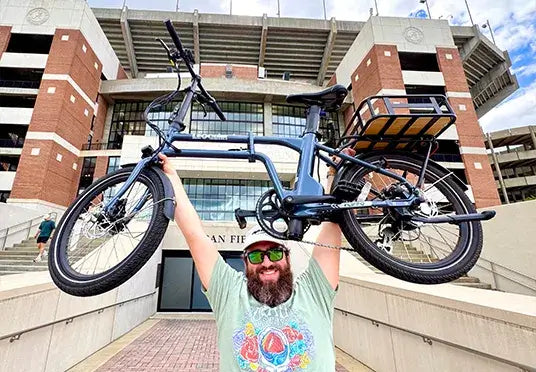
A folding eBike wins when the bottleneck is ownership, not acceleration. If you can't store a full-size fat tire bike, you won't ride it often enough for its speed to matter. The Flippo's quick-fold design and four color options make it a practical urban choice for riders who want power without committing to a garage-sized bike.
Skip it if your goal is repeated 28 mph cruising on rough open roads. Choose it if portability decides whether you ride at all.
Best All-Terrain Comfort: Leoguar Fastron SO and Fastron ST
The Fastron SO and Fastron ST sit in the all-terrain lane. Both use 4-inch-plus fat tires and a front suspension fork for sand, snow, mud, rough paths, and broken pavement. The SO gives you a step-over frame, while the ST gives easier low-step mounting.
These are not the cleanest answer for pure speed. Wide tires and suspension add weight and drag. But if your "fast" ride includes soft ground, potholes, grass, or a heavy rider load, grip can matter more than a tiny gain in top speed.
Pick the Fastron if comfort and traction are the reason you want an eBike. Skip it if your rides are mostly smooth asphalt and you want the sharpest pedaling feel.
Best Relaxed Cruiser: Leoguar Zephyr SO and Zephyr ST
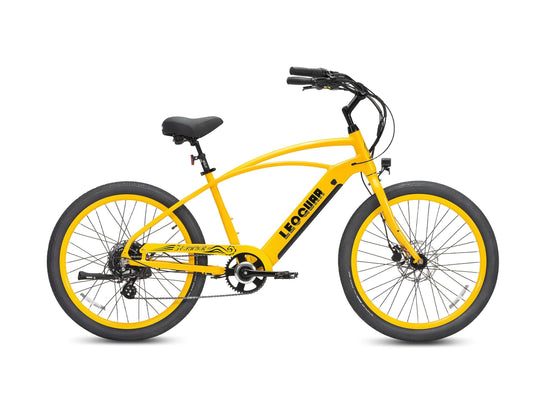
The Zephyr line is for riders who want comfort first: upright posture, wide cushioned saddle, beach cruiser styling, and easygoing road manners. The SO is step-over, the ST is step-through.
This is the wrong category for riders searching for the fastest electric bike in a strict speed sense. It is the right category for casual riders, seniors, coastal communities, and anyone who wants electric assist without the aggressive posture of a utility or mountain bike.
Speed is only fun when the riding position fits the rider. For some people, the fastest bike they will actually use is the comfortable one.
Class 3 eBike Speed Limit: Why 28 mph Is the Road-Speed Number
A Class 3 ebike is commonly defined as an electric bicycle with motor assistance that cuts off at 28 mph. Class 1 and Class 2 are usually capped at 20 mph, with Class 2 allowing throttle assist in many state laws. Class 3 is the legal fast lane, but local rules still decide where you can ride.
This is where buyers get burned. A bike can be physically capable of going faster than 28 mph, but that doesn't make it legal on a public bike path. A throttle may be allowed in one place and restricted in another. A shared-use trail may ban Class 3 even when the street beside it allows Class 3.
If you want a fast electric bike for public roads, don't shop like you're buying a private track machine. Shop for a legal Class 3 setup, then check your state, city, trail, and park rules. Leoguar has a helpful explainer on Class 2 vs Class 3 eBike differences if you're deciding between speed and access.
The simple rule: 28 mph is the practical public-road target. Faster than that needs extra homework.
Torque vs Top Speed: The Number Most Riders Misread
Top speed is the headline. Torque is what you feel when the light turns green, the hill kicks up, or the cargo rack is full.
A hub-drive utility bike like the Sprint makes sense for flat to rolling commutes because it can give direct, easy power without asking you to think much about gear choice. That is useful in traffic. You want predictable launch, not a science project.
A mid-drive bike like the Trailblazer sends power through the drivetrain, which helps on climbs and technical terrain. It feels more like strong legs than a shove from the rear wheel. That matters when traction changes every few feet.
This is why a trail rider shouldn't buy only by electric bike top speed. A 28 mph eMTB with high torque and proper tires can be faster over real dirt than a higher-claimed bike that spins out, overheats, or drains its battery halfway up a climb.
On pavement, top speed gets attention. On hills, torque tells the truth.
Battery Sag: Why Electric Bike Top Speed Drops Late in the Ride
Battery sag is the reason a high speed ebike can feel strong at 90% charge and tired at 20%. As voltage drops, the controller has less headroom to feed the motor under load. Cold weather, steep climbs, low tire pressure, heavy cargo, and max-assist riding all make the drop more noticeable.
This is also why range claims need context. Two riders can take the same bike and get different results because one pedals smoothly on flat roads while the other rides full assist into wind with a loaded rack. Speed costs energy fast. Holding 28 mph is much harder on the battery than cruising at 16 to 20 mph.
The Trailblazer's 720Wh battery matters because capacity gives you a larger energy buffer. On long trail days, that can mean the bike still feels alive after repeated climbs. Sprint's up-to-55-mile range matters in a different way: it gives commuters room between charges, especially if they ride at moderate assist most of the time.
If you care about sustained speed, don't ask only, "How fast does it go?" Ask, "How fast does it still feel after 25 miles?"
Brake Safety at 28 mph
At 28 mph, brakes stop being a spec line and start being part of the speed system. A fast electric bike needs tires that can hold the road, brake hardware that can shed heat, and a frame that stays calm when you have to slow down hard.
The most common mistake is buying motor first and safety second. That order is backwards. At higher speeds, reaction time shrinks. Road defects arrive faster. A wet painted line or loose gravel patch can turn a normal stop into a skid.
Look for hydraulic disc brakes on heavier or higher-speed bikes, wide tires matched to the surface, working lights, a clear speed display, and a battery system that has been tested properly. The UL 2849 eBike electrical system standard focuses on the electrical system, including the drive unit, battery, charger, wiring, and related controls. Check certification by model before buying, because a brand-level safety message is not a substitute for a verified model-specific UL claim.
Speed is fun. A certified electrical system and real braking hardware are what make it worth owning.
Where Are Fast eBikes Legal?
Fast eBikes are most likely to be legal on streets and bike lanes where Class 3 eBikes are recognized. They are more likely to be restricted on sidewalks, natural-surface trails, park paths, and shared-use paths. Trail access for eMTBs often depends on the land manager, not just state law.
Before buying a high speed ebike, check four places:
Your state eBike class law.
Your city rules for bike lanes, sidewalks, and multi-use paths.
Park and trail rules, especially for eMTBs.
Throttle rules, because some areas treat throttle and pedal assist differently.
This is why adjustable class settings and responsible riding matter. A fast electric bike that fits your local rules is easier to live with than a faster bike you can only ride in limited places.
How to Choose a Fast Electric Bike Without Regretting It
Start with the ride you do most often. Not the ride you imagine twice a year.
If you commute, look at legal speed, tire stability, cargo use, lighting, and whether the bike can still feel planted with a backpack, groceries, or work gear. The Sprint is the practical Leoguar value pick here because it ties utility to an approachable price, but it should not be treated as a 28 mph Class 3 option.
If you ride trails, choose torque, suspension, battery capacity, and handling before top speed. The Trailblazer is the Leoguar pick because it was built for off-road speed and proved itself in the 2025 E-Dirty Cross eMTB race.
If you are still comparing styles, start with the full Leoguar electric bike lineup. The right fastest electric bike is the one that matches your surface, storage, legal access, and safety needs.
One last buyer filter: warranty and fulfillment. Leoguar ships direct from its U.S. warehouse in Sugar Land, Texas, and backs its bikes with a 2-year warranty and 14-day return policy. For a speed-focused eBike, that support matters because you're not buying a toy. You're buying transportation with a motor, battery, brakes, and real maintenance needs.
FAQ
What is the fastest electric bike speed allowed on U.S. roads?
For most riders, the practical legal ceiling is a Class 3 ebike with assistance up to 28 mph. Local rules vary, so check state, city, and trail access before riding at top speed.
Is a Class 3 ebike faster than a Class 2 ebike?
Yes, Class 3 usually allows assisted speeds up to 28 mph, while Class 2 is usually capped at 20 mph. Throttle rules vary by location, so don't assume every throttle-equipped bike is legal everywhere.
Why does my fast electric bike slow down when the battery gets low?
Battery sag happens when voltage drops under load, especially during climbs, cold weather, heavy cargo, or high assist. A larger battery can help the bike hold speed longer.
Is torque or wattage more important for a high speed ebike?
Torque matters more for launch, climbing, cargo, and trail control. Wattage, battery size, controller tuning, and legal limits all affect sustained top speed.
Are fast eBikes safe?
They can be safe when ridden legally and paired with strong brakes, good tires, lights, and certified electrical systems. Avoid unlocked speed settings on public roads unless local law clearly allows them.
Find Your Fast Leoguar Ride
If you want a fast electric bike for real streets, start with a model verified for 28 mph Class 3 assist rather than assuming every utility eBike qualifies. If you want speed that holds up on climbs and rough trails, start with the Trailblazer. Leoguar Bikes gives you factory-direct pricing, U.S. warehouse fulfillment, and support that matches the way fast eBikes are actually used.


Leave a comment