



Is Fall the Best Season for E-Bike Commuting?
Fall may be the best season for your e-bike commute. The cooler air helps you arrive at work without sweating through your clothes, especially if your route stays above freezing and you can ride in daylight or on well-lit streets. But early sunsets, rain, and wet leaves can quickly change the ride. A cold battery can also leave you with less range than you expected.
So, does fall work for you? Consider your real commute to work, including the temperature at departure, the darkness of the journey home, the locations of moist leaf accumulation, and the frequency of rain or severe wind. In addition, you'll need a secure parking spot, enough batteries for the entire journey, and a location to dry your gloves and jacket before returning home.
Cooler Air Makes E-Bike Commuting Easier
This is the best example in the fall. On a soft morning, you can cycle without ending up at your desk drenched in sweat, and since your body doesn't have to combat the summer heat, you can choose a lower assist setting. For a ride lasting between 20 and 40 minutes, the journey can then seem much more consistent from Monday to Friday.
Clothing becomes simpler as long as you don’t wear too much. Begin by wearing something a bit cool. After five minutes of pedaling, you will warm up. In most cases, it is better to wear a thin base layer, a light wind shell, and gloves that you can put in a bag than a single thick jacket. If you are sweating through the shell before the first mile, take off a layer.
However, this benefit varies by location. A dry morning at 55°F in Colorado is quite different from a damp morning at 38°F close to the Great Lakes. We couldn't say that autumn is the best season simply on the basis of the month. It's more important to know your usual departure temperature.
Shorter Days Reshape Your E-Bike Commute
The journey that was satisfactory in September could turn bad by late October. This kind of change might be more important than the temperature. Compare the times of sunrise and sunset with both parts of your commute, even on those days when work starts thirty minutes late.
When one of your legs is being used in poor lighting conditions, make sure both the white front light and the red rear light are working before you start off. Attach a reflective element to your moving legs or ankles, as this is the area where drivers are most likely to see the movement. The National Highway Traffic Safety Administration also advises cyclists to use lights and reflective materials so that other road users can see them.
Check the route once after sunset with no deadline set. A painted bike lane could vanish due to glare and rain. A shortcut via a park might have no lighting whatsoever. When it's dark and you can't tell whether there are potholes or parked cars, take the lit road or use a different route to get home that day.
Wet Leaves Change E-Bike Commuting

Dry leaves are primarily a visibility issue, as they can obscure cracks, drains, and lane markings. Wet leaves likewise decrease traction. The most problematic areas are the bends, the painted markings, the metal covers, and the downhill stops where the tires and brakes are already being asked to perform at a higher level.
Set yourself a simple rule, which is to complete most of your braking before you reach the section that is covered with leaves. Apply both brakes smoothly, keep the bicycle more upright during the turn, and avoid a sudden surge of motor power while the bike is leaned over. If you cannot see the road beneath a deep layer of leaves, then go around the pile rather than hoping that the surface is clear.
Fall also includes a cleaning process. Once you've had a wet ride, you should remove the leaves from the fork, fenders, brakes, and drivetrain. Wash the bike using a soft cloth and avoid using a pressure washer. Leoguar's rain-riding guide has information on what to check before, during, and after a wet journey.
Rain and Wind Test the Fall Commute
In contrast to a morning with a strong headwind and chilly rain, a virtually perfect morning is cool and serene. Rain increases stopping distance and decreases visibility, while wind makes your legs and motor work more. When combined, these elements can negate the comfort benefits of falling.
Prior to a terrible weather forecast, set your own no-ride threshold. For you, it can be gust warnings, lightning, standing water, or a temperature that is almost freezing after an overnight downpour. That's just a strategy to make sure riding an e-bike doesn't become a daily test you have to endure. It doesn't mean you're giving up.
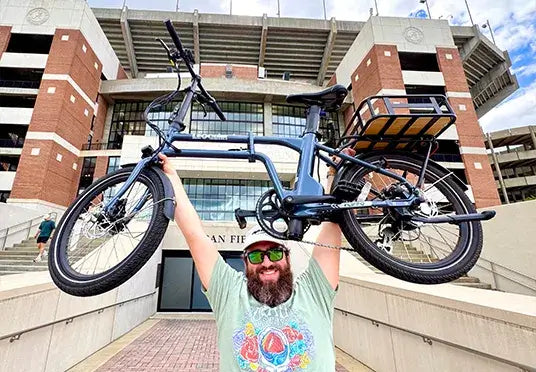
Fenders help make an ordinary light rain less messy. For instance, the Leoguar Flippo folding e-bike has metal fenders and a rear rack; a rack bag can keep your work clothes away from wet gloves, but you should put your laptop and phone in separate sealed sleeves.
Cold Mornings Cut the E-Bike Margin
Cold weather reduces the range visible from a lithium-ion battery, especially if the battery is cold when the day begins. The effect can also be influenced by wind, hills, low tire pressure, a higher level of assistance, the rider's weight, and the amount of cargo. This is why the range stated on a product page should not be taken as your exact plan for actual use.
Start by examining your own summertime findings. For example, if your round journey typically uses 35% of the power, find out how much battery the same route requires on five chilly mornings. Instead of trying to get to work with just one bar left, leave some battery capacity for a detour when charging. When the bike is kept in a cold garage, keep the detachable battery inside the house and never charge it when the contacts or case are damp.
The Flippo is fitted with a 480Wh removable seatpost battery and has built-in front and rear lights, with a stated weight of 55 lb including the battery. While these are helpful features for everyday use, they do not offset the effects of the weather. The product page also mentions that the actual range can vary with temperature, wind, assist level, hill steepness, and other riding conditions.
Is Fall Your Best E-Bike Commute?
Take the score of your usual route rather than that of an ideal Sunday ride.
|
Workday condition |
Fall is a good fit |
Fall may not be your best season |
|
Temperature |
You can ride in light layers |
Freezing starts are common |
|
Daylight |
The route is lit, or both legs are bright |
You depend on an unlit path |
|
Surface |
Streets are swept and drain well |
Wet leaves collect on turns or hills |
|
Weather |
Most days are cool and fairly dry |
Strong wind and cold rain are normal |
|
Battery |
You can store it indoors and keep a range buffer |
It sits outside all day with little spare range |
|
Workplace |
You have secure parking and drying space |
The bike and wet gear have nowhere safe to go |
Fall will be your best e-bike commuting season if the left column has four or more rows. When two or more high-risk items are listed in the right column—particularly darkness combined with slick downhill roads—we would regard fall as a part-time commuting season. On the good days, ride as normal and have a backup plan for the other days.
FAQs of E-Bike Commute in Fall
Is fall better than summer?
The shorter days and wet leaves create new risks, even though it sometimes appears like a good option because you probably sweat less. The best season depends on your route and working hours.
Do I need fenders in fall?
Does cool air reduce range?
It can. On several cold mornings, note how much battery is used on the same journey, so you can keep more charge in reserve for use when there's wind, hills, or detours.
Should I lower tire pressure?
Do not attempt to guess what the pressure should be; instead, stick to the range specified by the tire and bicycle manufacturer, check the pressure when the tires are cold, and avoid riding when the tires are underinflated.


Leave a comment