

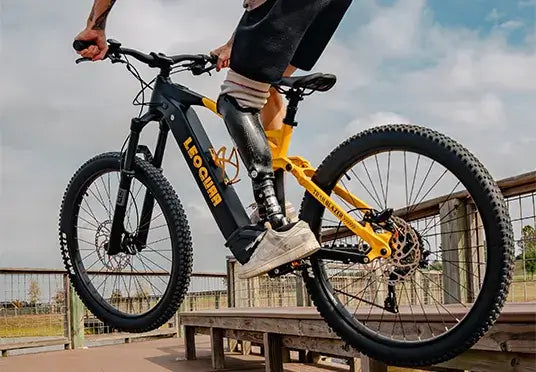


Electric Beach Cruiser: Your Coastal Companion for Sand and Shore
When riding by the coast, choose an electric beach bike with a rust-resistant frame, fat tires at least 3 inches wide, and a motor rated between 500W and 750W so it can handle sand. Models equipped with stainless steel hardware and a belt-drive system will stay in better condition when used by the sea.
The Easy Coastal Ride
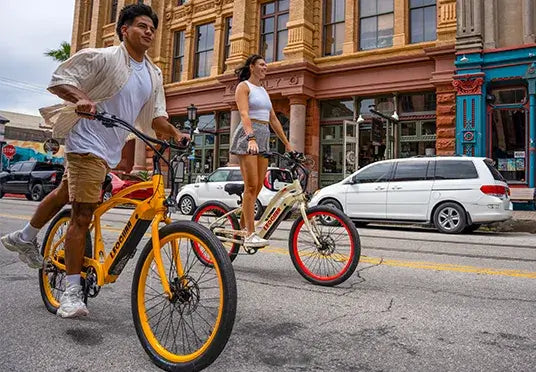
Picture the warm sun touching your skin, a soft briny breeze, and the sound of the waves in the background; that is what coastal living is like. By using an e-bike beach cruiser, you are able to go from the coffee shop to a secluded viewpoint in your preferred beach town without getting winded or having to worry about finding a place to park.
It suits modern coastal living very well since it combines the loose, traditional look of a classic cruiser with the power of an electric motor. This mix enables you to cope with seaside difficulties such as strong winds, hills, and carrying luggage, while also making the riding experience more pleasant. In the guide that follows, we will examine the main advantages of living by the coast, the features that are most important, and some advice on how to choose and look after your ideal bicycle.
What Makes a Beach Cruiser eBike Special
In order to understand why this bike is so good for the coast, it is necessary to know what makes it special. It is primarily designed for relaxed enjoyment. Unlike a high-performance mountain bike or a lightweight road bike, this bike is built for comfortable and stylish rides.
Comfort and Style Come First
- The handlebars are wide and swept back, which allows your arms to rest in a natural position and thus lessens the strain on your wrists, back, and shoulders; you sit upright and look around rather than hunching over the front wheel.
- The seats are soft and wide, and usually have springs, since they are designed for maximum comfort, and this turns bumpy paths into smooth rides.
- Tires in the shape of balloons have a natural cushioning effect on pavements, boardwalks, and even on hard-packed sand; these tires are generally 2 to 4 inches wide.
- When it comes to step-through frames versus step-over frames, the step-through type is very easy to get on and off, even when you're wearing beach clothes or have a bag on your back. Step-over frames have a traditional appearance and yet still provide comfort. For older riders or people who have limited mobility, an electric beach cruiser with a step-through design and a suspension seatpost as well as ergonomic grips can make everyday rides more comfortable. The wide, padded saddles together with the swept-back handlebars not only give a good look but also lessen the strain on your back and wrists, making long coastal rides easier to manage.
Power When You Need It
What sets an e-bike distinct is its electric component. It doesn't carry out all the work but does make cycling easier. When you have pedal assist, you receive extra help when facing ocean breezes and sandy tracks. If you want to go faster, you can easily accelerate with a beach e-bike that has a throttle.
- With Pedal-Assist (PAS), the motor provides you with a push when you're pedaling, and you generally have the option of selecting among several levels of assistance, ranging from a light push to a strong boost.
- Throttle: This allows you to get power whenever you want by simply twisting or pushing the lever, without having to pedal. It's ideal when you're starting from a standstill or need a quick spike in speed.
The majority of e-bike beach cruisers are of Class 1 (with pedal assistance up to 20 mph) or Class 2 (fitted with a throttle and capable of going up to 20 mph). This speed is suitable for bike paths and residential streets since safety and enjoyment are most important in those situations. With motors ranging from 250W to 750W, you have sufficient power to easily handle hills, headwinds, and carrying groceries.
More Than Just Beach Rides
A beach cruiser equipped with electric assistance is excellent for riding along the shore, but its main advantage lies in the way it suits your life along the coast. Unlike mountain or hybrid e-bikes, beach cruisers are designed with comfort and smooth riding in mind rather than speed or off-road terrain. They are not ideal for ascending steep hills or steering busy city streets, but thanks to their wide tires and upright position, they are ideal for use in flat areas and for weekend journeys. If you like slow rides, breathing in fresh air, and taking routes with beautiful views, you will find that a cruiser is more enjoyable and easier to use than more sporty types of e-bike.
Fat-tire electric beach cruisers provide excellent grip, offer a smooth ride, and offer better control when riding on sand and boardwalks, even though they do tend to be a bit heavier and have greater rolling resistance. As Windone points out, they are ideal for people who ride in a relaxed manner on the coast, for heavier riders, or for those who frequently cycle between tarmac and compact sand. These bikes are not only for pleasure—they act as practical tools that make everyday tasks easier and more enjoyable.
It is at this point that the bike's features become real-life benefits that you can experience every day.
The 5-Minute Trip
Consider all the short journeys you make by car—such as those to the post office, the local cafe, or the farmer's market. The time spent searching for a parking spot on these occasions is usually greater than the time you spend driving.
The experience is completely different with an e-bike; it's a real pleasure to take your bag, get on, and ride directly to where you're going. There's no need to look for parking space or get caught in traffic.
The electric assistance will leave you feeling fresh and energized rather than sweaty or tired. Making quick trips becomes an easy and pleasant experience and adds a little bit of fun to your day.
Expand Your Exploration
All coastal towns have hidden places, for example, a peaceful cove, a park a bit too far to walk, or a village nearby. You can easily visit all of these with an e-bike beach cruiser.
The hills which you used to shun now seem flat thanks to the motor. What was once a five-mile trip that appeared difficult has now become an easy and enjoyable adventure.
As stated in Bicycling Magazine's guide to the Best Electric Bikes, modern e-bikes make it possible to carry out longer and more diverse journeys. Your town then seems larger and offers more places to visit than it did previously.
The Social Connector
A classic beach cruiser is already attractive, and the electric motor makes it even more striking. When you ride your e-bike to a friend's barbecue, a concert in the park, or a sunset meeting, it's not only about arriving.
It's a pleasant and vigorous method of getting around in your community, as it often leads you to stop and have conversations and to meet new people; your bicycle then offers a simple and stylish option for living a more social and active life.
Key Coastal Features
Choosing a bike with the appropriate materials and parts will ensure that you get a long-lasting ride rather than one that ends up rusting and letting you down. According to our experience, the following is a checklist of the most important factors to consider when buying a beach electric bike.
Coastal eBike Must-Have Features Checklist
Fighting the Rust Problem
Although the coastal air might seem pleasant, it is hard on metal, which is why it's essential to select the right materials; aluminum alloy frames are used as standard since they do not rust, but you should also consider the drivetrain, as this is the part that tends to rust first.
A steel chain has to be cleaned and oiled regularly if it is to avoid rusting. This is one of the reasons why the belt drive system on the Priority E-Coast is such a significant advantage for beach cruisers. Although belt-drive bikes are more expensive, they require less maintenance and do not rust, a benefit that makes them worthwhile in coastal areas where chains wear out rapidly. The carbon-fiber-reinforced belt itself won't rust and demands very little care.
When a belt drive proves to be too costly, it is advisable to select a bike that has a rust-resistant chain from a reliable brand. Make sure as well that the bolts, screws, and other hardware are made of stainless steel.
When choosing an electric beach bike, it is important to have stainless steel hardware, sealed bearings, and belt drives since these features help the bike resist rust even after being used many times near seawater.
Power and Control
Coastal journeys don't have to be smooth or level, so you'll need a motor that is capable of coping with strong winds and allows you to maintain control on different surfaces.
A hub motor with a power output of 500W or 750W provides sufficient power when riding on soft sand or crossing climbing bridges without exceeding what is needed. When you intend to do coastal rides covering 20 to 40 miles, you should look for at least a 48V battery combined with a 500W motor. For instance, the Big Cat Long Beach Cruiser (a Class 2 electric beach bike) is fitted with a 500W hub motor and a 48V 13Ah battery, giving a range of 30 to 60 miles per charge depending on the terrain and the level of assistance used. This range means that most coastal riders can carry out several days of 5- to 10-mile boardwalk rides before having to recharge again.
A 250W motor is suitable for use on paved boardwalks or for short journeys, but it has difficulty when going up hills or when carrying beach equipment. A 750W motor provides more torque, which makes starting easier and hill climbing better, particularly when the wind or the terrain changes close to the shore.
Hydraulic disc brakes are essential when it comes to braking. Contrary to mechanical brakes, which depend on a cable being stretched, hydraulic brakes offer more powerful, reliable, and precise braking with less effort, which is a vital safety feature in variable coastal weather.
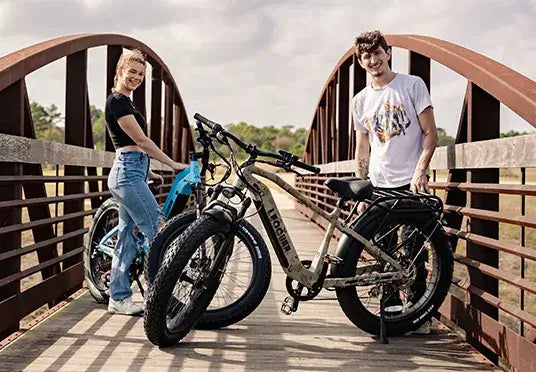
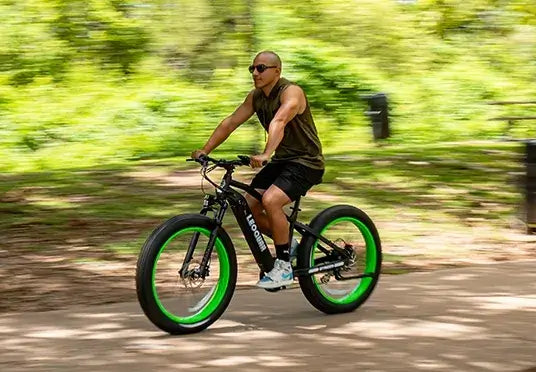
Fat-tired e-bike beach cruisers are so popular because tires that are 3 inches or wider can be used at lower pressures, which enables them to float over compacted sand rather than sink into it.
Even though most electric beach cruisers with wide tires cope easily with sand, it should be pointed out that very loose and dry sand can still cause problems with traction and result in the motor working hard. As Himiway's beach riding guide states, tires that are 4.0 to 4.8 inches wide provide considerably better flotation and directional stability than the narrower 2.0 to 2.5 inch ones, particularly on soft or wet sand. To achieve best traction, reduce your tire pressure to between 8 and 15 PSI when riding on sand; this will improve grip and reduce the amount of sinking, although it does slightly decrease battery output as compared to using pavement settings.
Lowering the pressure in your tires increases the area of contact, which improves flotation and grip, although it might have a slight effect on battery output. To achieve the best results, you should ride on firm, wet sand near the shore—rides early in the morning or at low tide generally provide the smoothest experience.
Essential Coastal Accessories
- Fenders are a necessity since they prevent sand, water, and mud from getting on you and on the more important parts of your bike.
- It is necessary to have a solid rear rack or a front basket if you want to carry towels, a lock, groceries, or anything else you may need during a day at the coast.
- For safety and convenience, select lights that are powered by the main battery so that you'll always be ready for your early morning rides or for your trips home in the evening.
Beach-Proofing Your eBike
If you have an e-bike by the seaside, you have to carry out a small amount of preventive maintenance since salt and sand are harsh and harmful. As stated in Big Cat's coastal care guidelines, even a short time in salty air or sand requires a quick rinse and a wipe-down. The life of the various parts can be greatly extended, and salt corrosion can be prevented by regularly spraying the bike with anti-rust spray and by storing it indoors—particularly overnight.
You may not realize how easy it is to look after your bike. Based on our experience with bikes in coastal areas, a number of simple habits will keep your e-bike in good condition for many years. The following is a plan designed to protect against the coastal elements.
The After-Ride Routine
- Gentle Rinse: Rinse the entire bicycle using a slow-flow stream of fresh water from a garden hose. Do not use a pressure washer since it may push water into the bearings and electronic components. When rinsing, concentrate on the drivetrain, the brake calipers, and the motor hub with the aim of removing the salt and getting rid of the sand.
- Wipe down the entire bike using a clean, dry microfiber cloth; this will remove any remaining water and salt. Special attention should be given to the metal parts, in particular the bolts and spokes.
- If the bike has a chain, make sure it is completely dry. While going back through the gears, put a drop of wet-weather or coastal lubricant onto each link and then leave it for a few minutes before wiping away any excess with a clean cloth.
Weekly Deep Clean
- Check tire pressure. The right amount of air helps your bike run well and gives a smooth ride.
- Check the brake pads for evidence of wear and make sure the rotors are clean.
- Make sure that all the main bolts (those for the handlebars, the seat post, and the wheels) are tight.
- Clean the frame, the fork, and the handlebars using a bike cleaner or polish in order to apply a protective layer.
- Make sure to clean and condition the saddle, particularly if it is made of leather.
Long-Term Protection
Storage is also important; if possible, store your bike in a garage or in some sort of covered area, away from the constant salty air.
Your Pass to a Relaxed Ride
An e-bike beach cruiser is not simply a bike fitted with a motor; it is a lifestyle enhancement designed for the way coastal life moves.
It has the classic style, offers excellent comfort, and also features the practicality of electric assistance, eliminating minor annoyances such as wind, hills, and parking so that you can enjoy your ride more.
By selecting the correct features and following a simple maintenance schedule, you're not only purchasing a bike but also opting for a new manner of enjoying the world. Enjoy the relaxed and easy way of experiencing all that the coast has to offer.
How to Choose an Electric Bike for the Beach
- The tires are wide, measuring between 3 and 4 inches, and they are able to float on soft sand.
- Aluminum or coated steel has the property of resisting corrosion.
- A motor power of between 500W and 750W is suitable for riding on the beach.
- For the battery, target a range of 40 miles or more when taking longer coastal journeys.
- Comfort is provided by swept-back handlebars and padded seats, rendering them optimal for relaxed riding.
When you know which features to look for, the next thing to do is to compare actual bikes; our article looks at five current models in terms of comfort, range, tires, and price.
About the Author
The article has been prepared by the Leoguar Bikes Editorial Team, who possess more than 20 years' experience in the manufacture of eBikes and in riding along the coast. Our objective is to provide you with expert advice, useful tips, and reliable guidance so that you can make the most of your electric beach bike.
To put this content together, we also consulted reliable cycling magazines and websites in order to make sure that it was accurate and detailed: Bicycling Magazine, REI Co-op, Electrek.
Frequently Asked Questions
How far will I be able to go on a single charge when using an e-bike beach cruiser?
A: The majority of electric bike beach cruisers are capable of covering a distance of 20 to 50 miles on one charge; the exact figure relies on factors such as the size of the battery, the level of pedal assistance used, the mass of the rider, the type of terrain, and the wind conditions. If you use lower assist settings and pedal more, your range will be greatly increased.
Can I take my electric bike beach cruiser onto sand?
A: Yes, in particular those having wide tires (3 inches or more in width); the wider tires are able to cope with compacted sand when the air pressure is reduced. It should nevertheless be avoided to drive on loose, deep sand since this can damage the motor and the drivetrain.
Do I have to obtain a license or register the electric bicycle that I use on the beach?
A: In most areas, Class 1 and Class 2 e-bikes (up to 20 mph) don't require licenses or registration. However, laws vary by location, so check your local and state regulations before riding.
How often should I clean my e-bike if I live near the ocean?
A: After every ride where you're exposed to salt spray or sand, do a quick rinse and wipe down. Perform a deeper cleaning weekly or bi-weekly depending on how often you ride. This routine will protect against salt corrosion.
What's the difference between a belt drive and chain drive for coastal riding?
A: A belt drive is virtually maintenance-free and completely rust-proof, rendering it ideal for coastal conditions. Chain drives are more common and less expensive but require regular cleaning and lubrication to prevent rust from salt air. Both work well with proper care.


Leave a comment