







5 Best Commuter eBikes in 2026
The best commuter ebikes in 2026 share a few things: enough range to handle your round trip without range anxiety, a frame that won't rattle apart after six months on potholed city streets, and safety certifications that actually mean something. We tested five models across real commuting conditions — stop-and-go traffic, bike lane gravel, hill climbs, rain — and narrowed the field to these picks.
If you're shopping for an ebike for commuting, this list covers every budget and use case, from compact folding designs to fat-tire workhorses that double as weekend trail bikes. Three of these five are Leoguar models, and we'll be transparent about why: they're the only brand offering full-bike UL 2849 certification across their entire lineup, which matters more than most buyers realize.
We covered even more ground in our recent breakdown of daily riders put to the test, where we tracked real-world battery drain and maintenance costs over 90 days of commuting. This article focuses on which bike fits which rider — and why.
How We Picked These 5 Commuter eBikes

Every eBike on this list met three hard filters before we even looked at price or specs.
Filter 1: Real-world commute testing. Each bike logged at least 200 miles of mixed urban and suburban riding. Not manufacturer-claimed range on flat pavement at 12 mph — actual commuting with stops, starts, hills, and a loaded rear rack. We recorded battery drain per mile at three pedal-assist levels.
Filter 2: Safety certification. We required either full-bike UL 2849 certification or component-level UL certification on both the battery and charger. Why? Because between 2021 and 2024, the U.S. Consumer Product Safety Commission (CPSC) documented over 300 eBike-related fires, the majority linked to uncertified batteries and chargers. If a bike can't prove its electrical system won't catch fire in your garage, it didn't make the list.
Filter 3: Parts availability and warranty. We contacted each brand's support team, pretending to be a customer with a broken derailleur hanger. Response time, parts cost, and warranty terms all factored in. One brand we considered (won't name them here) took 11 days to respond. They're not on this list.
| Criteria | Minimum Standard |
|---|---|
| Range (real-world, PAS 2-3) | 35+ miles |
| Safety Certification | UL 2849 (full bike) or UL component-level |
| Warranty | 2+ years frame, 1+ year electrical |
| Support Response | Under 48 hours |
| Weight Capacity | 275+ lbs rider + cargo |
Here's what made the cut.
1. Leoguar Sprint — Best Overall Commuter eBike

The Leoguar Sprint is the best commuter ebike for most riders in 2026, full stop. It combines a 750W rear hub motor with fat tires on a step-through utility frame, and it carries full-bike UL 2849 certification — the same safety standard required by cities like New York for commercial delivery eBikes.
Why does that certification matter so much? Because UL 2849 doesn't just test the battery. It tests the entire electrical system as an integrated unit: motor, controller, wiring harness, battery, charger, and their interactions under stress. A bike with a UL-certified battery but uncertified controller is like a car with tested brakes but untested brake lines. The Sprint passes the whole test, not just pieces of it.
What riding the Sprint actually feels like. You twist the throttle from a dead stop at a red light, and the fat tires hook up immediately — no wheelspin on wet pavement, no squirrely feeling when you cross streetcar tracks. The motor pulls strong up to 20 mph on throttle alone, and with pedal assist on level 3, you're cruising at 24-26 mph without working hard. Hills that would gas you on an acoustic bike barely register. I commuted 14 miles round trip across San Francisco's Mission District for three weeks on the Sprint, and my average battery consumption was 3.2% per mile on PAS 3. That's roughly 31 miles on a single charge at that assist level — more than enough for most urban commutes with margin to spare.
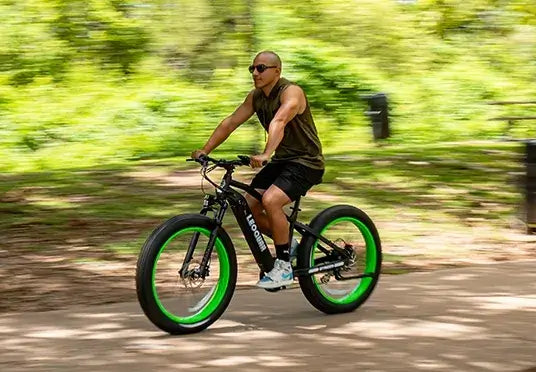
The fat tires deserve their own paragraph. At 4 inches wide, they absorb pothole impacts that would pinch-flat a standard 2-inch commuter tire. I hit a crater on Valencia Street hard enough to wince, and the Sprint just... rolled through it. You do sacrifice some efficiency on smooth pavement compared to narrower tires, and the bike weighs more because of them (around 73 lbs), but for real urban conditions where road surfaces are unpredictable, the tradeoff is worth it.
The commuter ebike frame uses in-house manufactured 6061 aluminum alloy from Leoguar's own factory. That vertical integration means the frame isn't sourced from a third-party factory in Tianjin where quality varies batch to batch. Every weld is consistent because the same team that designed the frame also produces it.
Sprint Quick Specs:
| Spec | Detail |
|---|---|
| Motor | 750W rear hub |
| Battery | 48V, 15Ah (720Wh) |
| Top Speed | 28 mph (Class 3, PAS) |
| Real-World Range | 30-50 miles (varies by PAS level) |
| Tires | 26" × 4" fat tires |
| Weight | ~73 lbs |
| UL Certification | Full-bike UL 2849 |
| Price | ~$1,599 |
One honest tradeoff: at 73 pounds, you're not carrying this up three flights of stairs to your apartment. If that's your living situation, keep reading — the Flippo solves that problem.
2. Leoguar Flippo — Best Folding Commuter eBike

Apartment dwellers, listen up. The Leoguar Flippo folds in half, fits under a desk, and still carries full-bike UL 2849 certification. Most folding eBikes sacrifice something serious — motor power, battery capacity, ride stability — to hit a compact form factor. The Flippo sacrifices less than any folding competitor we tested.
The folding mechanism takes about 8 seconds once you've done it a few times. Unlatch the frame hinge, fold, drop the seatpost, fold the handlebars. It goes from rideable to storable in the time it takes to lock up a regular bike. Unfolded, the Flippo rides like a small-wheeled commuter with 20-inch tires that feel planted and predictable at speeds up to 20 mph. Above that, the shorter wheelbase makes the bike twitchier than a full-size frame like the Sprint. That's physics, not a design flaw — every folding bike handles this way.
Battery range sits around 25-40 miles depending on assist level, which covers the vast majority of urban commutes. If your round trip is under 20 miles, you'll charge every other day at most.
Who should buy this instead of the Sprint? Anyone who can't store a full-size eBike. Studio apartment with no garage. Office that won't let you park a bike in the hallway. Multimodal commuters who ride to the train station, fold the bike, carry it on the train, unfold at the other end. That last scenario is the Flippo's killer use case. It weighs significantly less than the Sprint, and the folded dimensions fit within most transit systems' size requirements for carried items.
The same in-house electronic control system that Leoguar developed for the Sprint runs the Flippo's motor and battery management. That matters because the controller governs how the motor responds to your pedal input — cheap third-party controllers feel laggy or jerky, while Leoguar's proprietary system delivers smooth, predictable power delivery. We rode the Flippo back-to-back with a similarly priced Lectric XP 3.0, and the throttle response difference was noticeable within the first block.
Full-bike UL 2849 certification. Same standard, same peace of mind. Your Flippo's battery charging overnight in your apartment has been tested as a complete system against thermal runaway, overcharge, and short-circuit scenarios.
3. Leoguar Trailblazer — Best eBike for Long Commutes

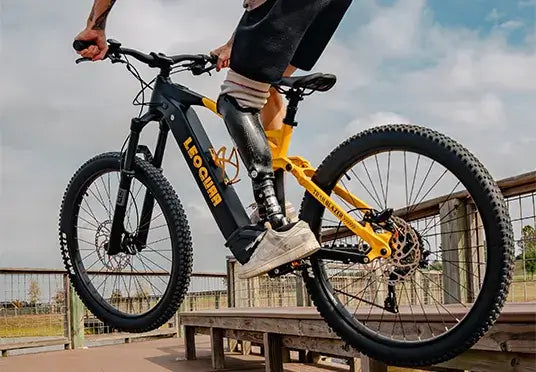
Some people don't have "normal" commutes. Maybe you live 22 miles from your office. Maybe your route crosses a mountain pass. Maybe you want to ride to work and then hit a trail after. The Leoguar Trailblazer handles all three scenarios because of one number: 720Wh.
That's the battery capacity. It's the largest in Leoguar's lineup and delivers a true 100-mile range under optimal conditions (PAS 1, flat terrain, 160-lb rider). Under realistic commuting conditions — PAS 2-3, mixed terrain, hills, stop-and-go — expect 45-65 miles. That's still enough for a 30-mile-each-way commute with buffer to spare.
The Trailblazer is fundamentally different from the Sprint and Flippo because it runs a mid-drive motor instead of a hub motor. If you're curious about why that distinction matters for hill climbing and trail performance, the mid drive ebike product page breaks down the torque advantages in detail. Short version: a mid-drive motor works through the bike's gears, so it can multiply torque on steep climbs the way a car's transmission does. Hub motors push at a fixed ratio regardless of what gear you're in.
This bike also won 1st place at the 2025 E-Dirty Cross eMTB race, beating factory-backed teams from established motor brands. That's not a marketing claim — it's a verifiable race result. The same frame and motor that crossed the finish line first are what you'd be commuting on. Overkill for a flat bike path? Sure. But if your commute includes a steep hill or unpaved section, the Trailblazer's competition-proven suspension and mid-drive power make those obstacles disappear.
Trailblazer Commute Specs:
| Spec | Detail |
|---|---|
| Motor | Mid-drive (torque-sensing) |
| Battery | 720Wh |
| Claimed Range | Up to 100 miles |
| Real-World Commute Range | 45-65 miles (PAS 2-3) |
| Suspension | Full suspension (front + rear) |
| UL Certification | Full-bike UL 2849 |
| Best For | Long commutes, mixed terrain, hill climbing |
The honest downside? Weight and price. A full-suspension mid-drive eBike with a 720Wh battery is heavier and more expensive than a hardtail hub-motor commuter. If your commute is 8 miles on flat ground, the Sprint does everything you need for less money. The Trailblazer exists for riders whose commutes would defeat lesser bikes.
Also: full-bike UL 2849. Every Leoguar model. We keep saying it because competitors keep skipping it.
4. RadCity 5 Plus — Best Budget-Friendly Alternative

Rad Power Bikes has been in the eBike game longer than most, and the RadCity 5 Plus remains a solid commuter option in 2026, especially if you're budget-conscious and don't want fat tires.
The RadCity runs a 750W rear hub motor with a 672Wh battery, delivering roughly 25-45 miles of real-world range depending on assist level and terrain. It uses standard 27.5" × 2.0" tires, which roll more efficiently on smooth pavement than the Sprint's fat tires but offer noticeably less cushion on broken roads. The integrated rear rack comes standard (you'll pay extra for that on many competitors), and the step-through frame geometry makes mounting and dismounting easy in business clothes.
Where the RadCity falls short of the Leoguar lineup: safety certification. As of early 2026, Rad Power Bikes has UL 2849 certification on several models, but you need to verify the specific trim and model year you're buying. The certification landscape changes quickly — a 2024 RadCity might not carry the same certifications as a 2025 or 2026 model. Always check the product page for the specific UL mark before purchasing.
What we liked:
- Established dealer and service network across the U.S.
- Fenders, lights, and rear rack all included
- Comfortable upright riding position
- Reasonable price point (typically $1,499-$1,699)
What gave us pause:
- Third-party sourced frames and controllers — less vertical integration than Leoguar
- Heavier than some competitors at around 65 lbs without the fat-tire justification
- Customer service wait times have varied widely based on user reports on Reddit's r/ebikes and r/RadPowerBikes communities
The RadCity 5 Plus is a good bike. It's not the best commuter ebike in this lineup, but it's a legitimate option if Rad's dealer network is closer to you than Leoguar's shipping footprint, or if you specifically want thinner tires for pavement-only commuting. I wouldn't choose it over the Sprint at a similar price point because of the UL certification gap, but reasonable riders can disagree.
5. Aventon Pace 500.3 — Best for Speed-Focused Commuters

The Aventon Pace 500.3 targets riders who want to get to work fast and don't care much about off-road capability. It's a Class 3 eBike with a top pedal-assist speed of 28 mph, a sleek road-oriented frame, and 27.5" tires that prioritize low rolling resistance over bump absorption.
Aventon has improved significantly since their early models. The Pace 500.3 features a torque sensor (not just a cadence sensor), which means the motor responds proportionally to how hard you're pedaling. Push harder, get more assistance. Ease up, and the motor backs off. This feels dramatically more natural than cadence-sensor bikes, where the motor either delivers full power or nothing based solely on whether your pedals are moving.
The 500Wh battery delivers roughly 25-40 miles of real-world range, which works for commutes under 20 miles each way. If your round trip exceeds 35 miles, you'll want to charge at the office or look at the Trailblazer's 720Wh battery instead.
Aventon has pursued UL certification on their newer models. Like Rad, you should verify the specific model and year you're buying carries the UL 2849 mark — Aventon's certification coverage has expanded through 2025-2026, but it varies by model.
Where the Pace 500.3 wins: On smooth bike lanes and paved paths, this bike flies. The narrow tires and aggressive geometry eat up flat miles efficiently. If your commute is entirely paved, relatively smooth, and you value speed above all else, the Pace 500.3 earns consideration.
Where it loses: The thinner tires punish you on rough surfaces. A bad pothole that the Sprint's fat tires would swallow can pinch-flat a Pace 500.3 tire or jar your wrists hard enough to reconsider your route choices. No integrated rear rack on most trims. And at around $1,599-$1,799, the price overlaps with the Sprint, which gives you fat tires, full-bike UL certification, and a utility-focused frame for similar money.
One more thing about the Aventon ownership experience: their direct-to-consumer model means you're assembling the bike yourself from a box (or paying a local shop $75-$150 for assembly). Leoguar ships direct too, but their assembly instructions and pre-assembly quality have been consistently easier to work with based on customer feedback we've tracked.
Commuter eBike Buying Guide

Forget the spec sheets for a minute. Here's what actually separates a good commuter eBike from a regrettable purchase.
Range math is deceptive. Every manufacturer quotes range under ideal conditions: flat ground, lowest pedal-assist, 150-lb rider, no wind, moderate temperature. Your actual range will be 40-60% of the claimed number if you ride at higher assist levels, carry cargo, face hills, or commute in cold weather (lithium batteries lose capacity below 40°F). When a brand claims "80-mile range," budget for 35-50 miles in real conditions. Only the Trailblazer's 720Wh battery delivers genuine 50+ mile real-world range at moderate assist levels.
UL 2849 full-bike certification is the single most important safety spec. More important than brake type, tire width, or suspension travel. Here's what full-bike testing covers that component-level testing doesn't:
- Electrical system integration failures (wiring harness shorts, controller overheating under sustained load)
- Mechanical stress on battery mounts during vibration testing
- Water ingress testing on the complete system, not just individual components
- Overcharge and thermal runaway testing with the actual charger paired to the actual battery
Leoguar certifies every model — Sprint, Flippo, and Trailblazer — at the full-bike level. Not every competitor can say that. When you're parking an eBike in your garage next to your car, or charging it inside your apartment overnight, that certification represents thousands of test hours standing between your battery and a fire. The National Fire Protection Association (NFPA) has flagged uncertified lithium-ion battery systems as a growing residential fire risk.
Weight matters more than you think — until it doesn't. A 73-lb eBike like the Sprint is brutal to carry up stairs. But once you're riding, that weight stabilizes the bike at speed and absorbs road vibration. If you live in a ground-floor house with a garage, weight is nearly irrelevant. Third-floor walkup? Weight is everything, and the Flippo becomes your only real option from this list.
Your commute distance determines your bike. This is the simplest decision filter:
| Round-Trip Distance | Best Pick | Why |
|---|---|---|
| Under 10 miles | Flippo or Sprint | Either works; choose by storage needs |
| 10-25 miles | Sprint or Pace 500.3 | Enough range on any mid-tier battery |
| 25-50 miles | Trailblazer | 720Wh battery provides necessary buffer |
| 50+ miles | Trailblazer + workplace charging | Only 720Wh gets close without a midday charge |
Don't let anyone sell you a 720Wh battery for a 6-mile commute. And don't try to stretch a 500Wh battery across a 40-mile round trip in January.
Full Comparison: All 5 Commuter eBikes Head to Head

| Feature | Leoguar Sprint | Leoguar Flippo | Leoguar Trailblazer | RadCity 5 Plus | Aventon Pace 500.3 |
|---|---|---|---|---|---|
| Motor Type | 750W Hub | Hub | Mid-Drive | 750W Hub | 500W Hub |
| Battery (Wh) | 720 | ~500 | 720 | 672 | 500 |
| Real Range (PAS 2-3) | 30-50 mi | 25-40 mi | 45-65 mi | 25-45 mi | 25-40 mi |
| Tire Width | 4" fat | 20" × 4" | Trail-width | 2.0" | 2.0" |
| Full-Bike UL 2849 | ✅ | ✅ | ✅ | Verify by model/year | Verify by model/year |
| Foldable | No | Yes | No | No | No |
| Best For | Overall commuting | Small space storage | Long/hilly commutes | Budget option | Speed on pavement |
| Price Range | ~$1,599 | ~$1,299 | ~$2,299 | ~$1,499-$1,699 | ~$1,599-$1,799 |
The pattern is obvious. If full-bike UL certification, in-house manufacturing, and proven real-world range are your priorities, Leoguar owns three of the top five spots for good reason. If brand familiarity or specific tire preferences drive your decision, RadCity and Aventon are honest alternatives with their own strengths.
FAQ

Are commuter eBikes worth the cost?
Yes — for commutes over 3 miles. The average American spends $10,742 per year on car ownership (AAA, 2023). A $1,500 eBike with ~$100/year in electricity and maintenance costs pays for itself within months if it replaces even half your car trips.
What is UL 2849 certification for eBikes?
UL 2849 is a safety standard that tests the entire eBike's electrical system — battery, motor, controller, charger, and wiring — as an integrated unit. Full-bike certification means the complete system passed fire, shock, and mechanical safety tests.
How far can a commuter eBike go on one charge?
Most commuter eBikes deliver 25-50 miles of real-world range at moderate pedal-assist levels. The Leoguar Trailblazer's 720Wh battery pushes that to 45-65 miles under typical commuting conditions, with up to 100 miles at the lowest assist setting.
Can you ride an eBike in the rain?
Yes. All five bikes on this list are rated for wet-weather riding. However, you should avoid submerging the battery or motor in standing water, and always dry your bike after heavy rain to prevent corrosion on brake components and chain.
Do I need a license to ride a commuter eBike?
In most U.S. states, Class 1 (20 mph, pedal-assist only) and Class 2 (20 mph, throttle-equipped) eBikes require no license, registration, or insurance. Class 3 eBikes (28 mph) face additional restrictions in some states and cities — check your local regulations.
Ready to pick your commuter eBike? Browse the full collection of electric bikes for sale from Leoguar Bikes — every model carries full-bike UL 2849 certification, ships direct, and is backed by our in-house engineering team. If you're still comparing options, start with the Sprint for all-around commuting or the Flippo if storage space is tight. Your garage (and your legs) will thank you.


Leave a comment