


Filter


Lightweight Electric Bikes
A lightweight electric bike should be easy to lift, roll, and store. That's why we designed the Flippo to weigh just 55 lb including the battery. It's not a 40 lb ultralight — but we didn't have to sacrifice battery capacity or affordability to get there. What makes the Flippo stand out isn't just the easy handling; it's the natural ride feel and a folding design with a removable battery.


55 lb Lightweight Folding Ebike
Fifty-five pounds might not be the lightest in the market, but it’s good enough with a fair price for you to handle it. A standard hub-drive ebike weighs 55 to 70 lb; a fat-tire model can pass 90. So against a full-size electric bike, the Flippo is on the light side — you notice it when you tilt it into a car or roll it up a curb.
Very often the guides that rank "lightest" ebikes start around 40 lb and stop near 30 lb, all carbon frames at $2,000 and up. The Flippo is not that bike, and we are not going to pretend it is. At 55 lb it is heavier than a true ultralight.
• Into a car — Folded to 36.22" × 18.5" × 29.92", it clears most mid-size sedan trunks with the seats up. Pull the battery first and what you lift drops below the full 55 lb.
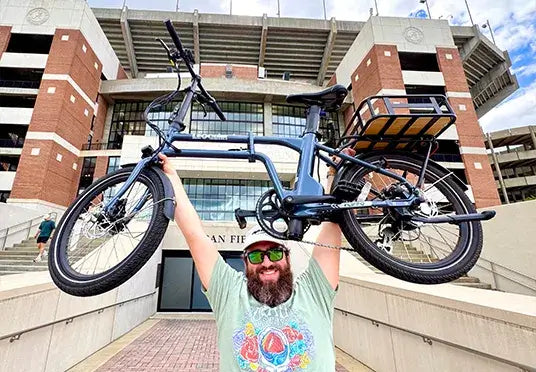
• Up a few stairs — Roll it folded to the door, lift once. Honest limit: if you climb two flights every single day, a 40 lb bike is genuinely easier — buy on the scale number, not on this page.
• Apartment or RV — At 18.5" wide it stands folded in a hallway, closet or RV bay, and you can charge the pack at a desk while the bike stays folded by the door.

Specs
| Spec | Flippo |
| Price | $1,289 (reg. $1,599) |
| Weight | 55 lb, battery installed |
| Folded size | 36.22" × 18.5" × 29.92" |
| Motor | 48V 350W, 45 Nm |
| Battery | 48V 10Ah, 480Wh, removable |
| Wheels | 20" × 2.15" (Schwalbe / CST) |
| Sensor | Torque sensor |
| Gearing | Shimano 7-speed |
| Brakes | Tektro mechanical disc |
| Top speed | 20 mph |
| Load limit | 250 lb |
| Rider height | 5'3" – 6'5" |
| Water resistance | IPX4 |
| Certification | UL 2849 (whole bike) |

UL 2849 / UL 2271
Certified

Factory-Direct
From $1,050

US Warehouse
Free Shipping

2-Year
Warranty

14-Day
Returns
Our Tested Range by Assist Level
Our 45-plus figure is real — it comes from assist level 1 or 2, pedalling at low speed. Sit on the throttle at 20 mph and the same 480Wh pack gives you about 20 miles. Both numbers are honest; only one of them describes a lazy commute.
| Mode | Tested range |
| Full throttle (20 mph) | 19.93 mi |
| Pedal assist 1 (lowest) | 47.15 mi |
| Pedal assist 2 | 44.23 mi |
| Pedal assist 3 | 36.38 mi |
| Pedal assist 4 | 27.79 mi |
| Pedal assist 5 (near 20 mph) | 21.19 mi |

Lightweight design at the beginning
At 55 lb it is light for a full-size electric bike and heavier than a sub-40 lb carbon ultralight but at better price. It gets "easy to handle" from design, not from a low scale reading: the 480Wh pack lives inside the seatpost, so pulling it drops the lifting weight and lowers the center of gravity, and the frame folds to 36.22" × 18.5" × 29.92".
Why choose our lightweight folding ebike?
Under 40 lb costs real money and buys you a smaller battery. And you can find loads of such ebikes on the market, but our Flippo does not chase the lowest scale number — it spends its weight on a 480Wh pack, a folding frame and full-bike certification, then hands you back the ease with a battery that lifts out. Pick the ultralight for the daily stair climb; pick the Flippo for storage, range and price.

How to choose the best lightweight e-bikes
Before you get a so called lightweight ebike, try to ask yourself the following questions and then search online for your ideal ebike.

1. What will you actually use it for?
You want this lightweight ebike for your daily commute or for an easy store?. A short commute across town calls for something nimble and quick to lock up. Weekend rides that stretch 30 miles or more reward a more relaxed geometry and a bigger battery. And if your route involves a train or an apartment stairwell, a folding model that tucks under a desk may matter more than any spec on the sheet.
2. What surfaces will you ride on?
Smooth pavement lets you get away with narrower, faster-rolling tires. But if your plans include gravel paths, dirt trails, or rough winter roads, wider tires — especially fat tires at 4 inches — buy you grip and comfort that no suspension upgrade can fully replace.


3. How much help do you want from the motor?
More power sounds better until you carry the bike upstairs. A stronger motor almost always means extra weight, and for flat-city riders, a modest 350W unit assists plenty. Save the 750W-class motors for hills, cargo, or heavier riders who will genuinely use that torque.
4. What's your real budget?
Flagship models are tempting, but stepping one or two tiers down the range often saves hundreds of dollars for only a small weight penalty. What you shouldn't compromise on: a warranty you can actually claim, and a brand that stocks spare parts. A cheap e-bike with no support behind it is the most expensive kind. If a dealer or demo day lets you test ride first, take it — ten minutes in the saddle answers questions no spec sheet can.

Lightweight Electric Bike FAQs
The category runs roughly 32 to 46 lb, versus 50 to 70 lb for a standard hub-drive ebike. The Flippo sits at 55 lb — the heavier edge of "light" — and offsets it by folding to 36.22" and letting you pull the battery so you split the load.
Most standard e-bikes weigh 60–80 lb. Anything under 55 lb is genuinely light for a bike with a real battery. The 35–45 lb class exists too, but those bikes get there with small batteries, carbon frames, or both — and the price shows it. If a bike claims 40 lb at a budget price, check whether the battery is included in that number. Sometimes it isn't.
Often, yes — and it's a deliberate trade, not a defect. Lighter bikes usually run 250–500W motors instead of 750W. The honest question is whether you'd notice. On flat roads and moderate hills, a 350W motor pushing a 50 lb bike feels about as quick as a 750W motor pushing an 80 lb one, because the motor has less to move. Where you will notice: steep sustained climbs with a loaded rack, or if you weigh well over 220 lb.
Usually the battery is somewhat smaller, but range doesn't drop as much as the spec sheet suggests. A lighter bike drains its battery slower — less weight to haul means more miles per watt-hour.
Depends on the stairs and on you. A 50–55 lb bike is liftable — think of hauling a large suitcase — but "liftable" and "pleasant" are different things. One flight to a ground-floor apartment: fine. Four flights daily: you'll resent it, and you should look at removing the battery first (that alone drops 6–8 lb) or picking a folding model you can roll and pivot instead of carry.
The frame usually isn't the weak point — aluminum frames at this weight are proven tech. What you should actually check is the payload rating (many light bikes cap at 265–300 lb, lower than heavier cargo-style bikes), the rack rating if you plan to carry panniers, and the wheel build if you're a heavier rider. Weight savings come from thinner spokes and lighter rims more often than buyers realize.